Executive Summary
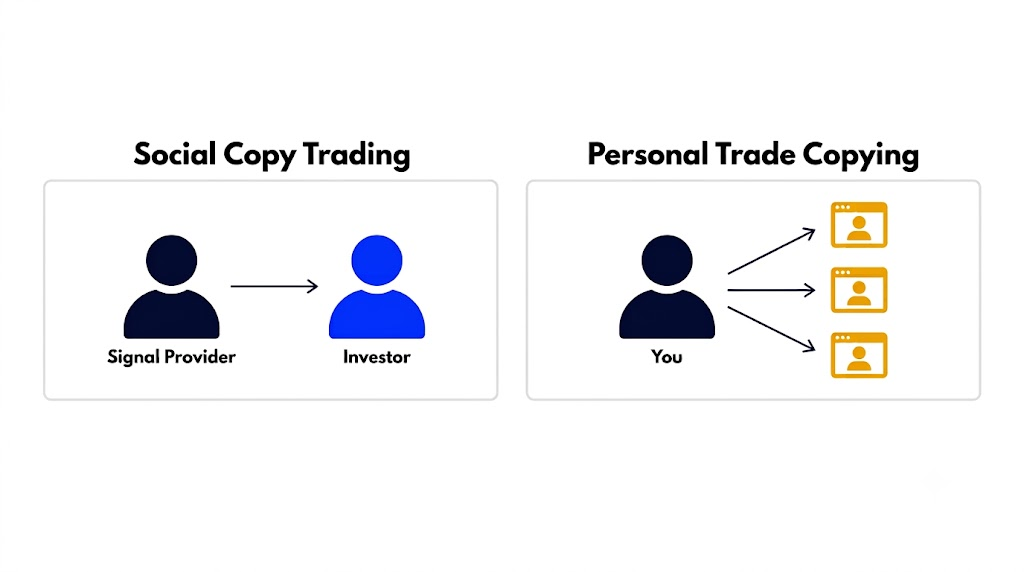
Copy trading automatically replicates trades from one account to another. The term covers two distinct activities: social copy trading, where an investor follows another trader’s positions through a platform, and personal trade copying, where a trader replicates their own trades across multiple accounts they control, common in prop trading for managing several evaluation accounts.
What Is Copy Trading?
Copy trading is a process that automatically replicates trades from one account to another. When a trade is placed in the source account, the same trade is executed in the connected account based on the settings chosen before the connection was activated.
The term “copy trading” is often used to describe two different activities. One involves following another trader’s decisions through a social trading platform. The other involves a trader copying their own trades across multiple accounts for efficiency and consistency.
Copying Another Trader’s Trades
In social copy trading, an investor chooses a trader to follow through a platform. This trader is often referred to as a signal provider, the individual or strategy whose trades are made available for others to copy. When that trader buys or sells an asset, the same trade is automatically placed in the investor’s account. The platform handles the process behind the scenes.
Trades are typically scaled according to a copy ratio (sometimes called a scaling ratio). This determines how position sizes from the source account are adjusted to match the size of the follower’s account. For example, if a trader allocates half as much capital as the source account, copied trades may also be opened at roughly half the size, rather than copied dollar-for-dollar.
This type of copy trading is common in markets such as forex, CFDs, stocks, and futures. The goal is to gain market exposure without making every trading decision independently. However, it is generally not permitted at futures evaluation firms such as Apex Trader Funding, where each participant is expected to make and execute independent trading decisions.
Copying Trades Between Your Own Accounts
Personal trade copying works differently. Instead of following someone else’s decisions, the same trader controls all of the accounts involved.
For example, a trader managing several evaluation accounts may place a trade in one account and use trade-copying software to replicate that trade across the others. This allows positions, stop-loss orders, and profit targets to remain consistent. In this situation, copy trading functions as a trade-management tool rather than an investment strategy.
How Does Copy Trading Work?
Copy trading works by connecting a source account to one or more destination accounts. Once the connection is established, trades entered in the source account are automatically replicated according to the settings chosen by the user.
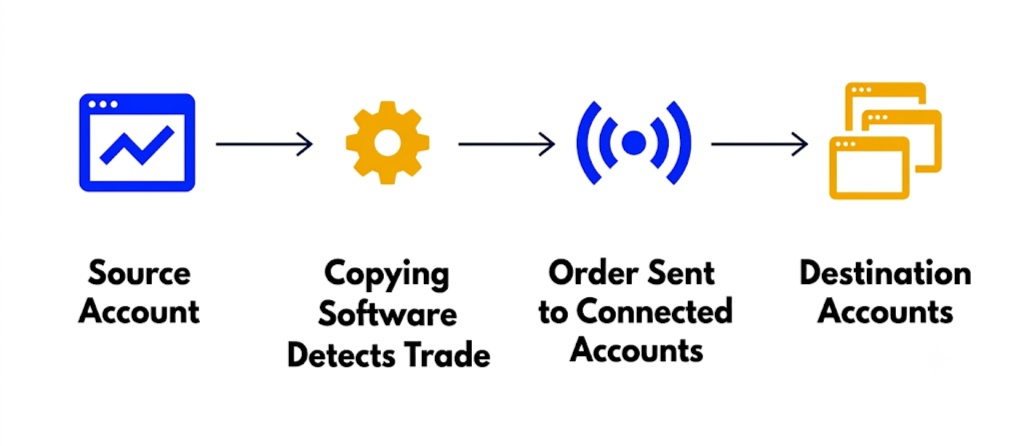
A source account is the account where trades are originally placed, which the software monitors, and destination accounts are the connected accounts that automatically receive the same trades.
How Social Copy Trading Works
A typical social copy trading workflow follows several steps:
- Select a trader. The user chooses a trader or strategy available through the platform.
- Set an allocation. An amount is assigned to the selected strategy.
- Replicate trades. The platform copies the trader’s activity into the connected account.
- Monitor results. The user can review the performance of the copied trades.
The exact process and available controls vary between copy-trading platforms such as MetaTrader 5 (MT5) or cTrader.
How Personal Trade Copying Works
When traders copy their own trades, the process focuses on execution efficiency rather than following another person’s strategy.
Personal trade copying is usually done using trade copier software, Expert Advisors (EAs) for Tradovate and Rithmic, API-based tools, or trade replication software. These tools automatically copy your own trades from one account to multiple accounts. Unlike social copy trading, you stay in full control of the accounts and the trades being copied.
A common workflow looks like this:
- A trade is entered in the primary account. This becomes the source account that controls the trade.
- Trade-copying software detects the order. The software immediately sends the same order to connected accounts.
- Risk settings are applied. Traders can choose whether every account receives the same position size or whether trades are adjusted based on account size.
- Changes are synchronized. Stop-loss adjustments, profit targets, and position closures can also be copied automatically.
This approach helps maintain consistency when managing multiple accounts at the same time.
Why Do Traders Use Trade Copying?
Trade copying is primarily used to improve efficiency and consistency. Rather than entering the same trade repeatedly across several accounts, traders can automate the process and reduce the chance of differences between accounts caused by manual entry timing.
Saving Time
Without trade-copying technology, a trader managing several accounts would need to manually enter every position, stop-loss, and target multiple times.
This process can be slow and may create differences between accounts if market prices change while orders are being entered. Trade copying helps ensure that all accounts receive the trade at nearly the same time.
Managing Multiple Accounts
Some traders operate multiple personal accounts, while others may participate in several evaluation programs simultaneously.
Managing each account separately can become difficult as the number of accounts increases. Trade-copying software allows traders to monitor a single execution process rather than repeating the same actions throughout the day.
Maintaining Consistent Execution
Consistency is one of the primary reasons traders use trade copiers. If a trader’s strategy calls for a specific entry, stop-loss, and target, copying the trade helps ensure those parameters remain aligned across accounts. This reduces the likelihood of accidental differences that could affect performance.
Copy Trading for Prop Firms: Social vs. Personal Trade Copying
A proprietary trading firm (or prop firm) is a company that allows traders to access firm-provided capital after demonstrating their skills. Many firms, like Apex Trader Funding, use an evaluation program, sometimes called an evaluation account, where traders must meet specific performance and risk-management requirements before becoming eligible for a funded account. Because traders may manage multiple evaluation or funded accounts, personal trade-copying tools are sometimes used to help maintain consistent execution across those accounts.
This is different from social copy trading, where an investor follows another trader’s decisions. In personal trade copying, the trader remains responsible for all entries, exits, and risk-management decisions.
| Factor | Social Copy Trading | Personal Trade Copying |
| Decision Maker | Another trader | You |
| Primary purpose | Following a strategy | Managing multiple accounts |
| Common users | Investors and beginners | Active and prop traders |
| Barrier to Entry | Lower | Higher |
Because prop firms often have specific rules regarding copied trades, understanding the difference between social and personal copy trading is important before using any trade-copying software. Firms may review account activity, trading patterns, and standard account-access information when assessing behavior that may conflict with their platform policies.
What Risks Should Beginners Understand Before Using Copy Trading?
The primary risks in copy trading include performance variability across market conditions, drawdown replication across connected accounts, execution price differences due to latency, and position-sizing mismatches between accounts. Each of these can be managed with the right setup and active oversight, making them important to understand before enabling any copy trading connection.
The most important risks beginners should understand include:
- Copied trades replicate the full range of outcomes from the source account, including periods of drawdown. A drawdown is a decline in account value from a previous peak. Monitoring drawdown levels on the source account and setting a maximum allocation limit helps keep this exposure within manageable boundaries for each connected account.
- Execution differences can occur. Slippage, the difference between an expected price and the actual execution price, and latency, the small delay between the source trade and copied trades, can sometimes cause connected accounts to receive slightly different fill prices, particularly during fast-moving market conditions.
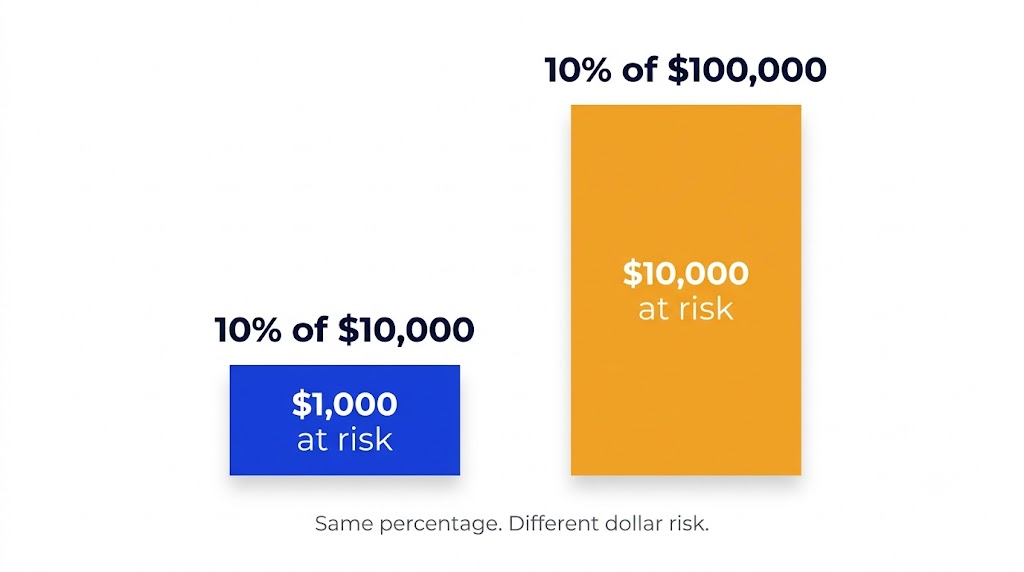
- Risk levels may not match your goals. A trade size that feels appropriate in one account may not align with another trader’s risk tolerance or account size. For example, a trade sized at 10% of a $10,000 account would be $1,000, while the same 10% sizing on a $100,000 account would be $10,000. This difference shows why position sizing must be tracked carefully, as the same strategy percentage can lead to significantly different dollar risk depending on account size.
Active monitoring is part of using copy trading well. Automation handles execution, but reviewing performance, checking open positions, and adjusting settings when market conditions change remains the trader’s responsibility.
Before using copy trading, beginners should understand how much capital is at risk, how trades will be sized within their account, and what controls are available if they decide to pause or stop the copying process. Many copy trading platforms also allow users to set a maximum allocation or risk cap, a setting that limits how much capital can be assigned to a particular trader or strategy, preventing a single copied strategy from affecting the entire account.
Conclusion
Copy trading is a broad term that can refer to either following another trader’s positions or automatically replicating trades between your own accounts.
For traders working through evaluation programs or managing multiple accounts, understanding how personal trade copying works can help create a more organized trading workflow. Firms such as Apex Trader Funding provide structured evaluation environments where consistency, risk management, and adherence to trading rules remain just as important as the tools used to execute trades. Ultimately, successful trade copying starts with disciplined decision-making and personal accountability for every position taken.
Disclaimer: Trading financial markets involves risk, and results can vary. Past performance does not guarantee future outcomes. Trade responsibly and use capital that aligns with your financial goals and risk tolerance.
FAQs
Is copy trading the same as a signal service?
No. When a trader copies their own trades between accounts they personally control, the trading decisions still originate from that same individual — the software functions as a trade-management tool, not a signal service. Social copy trading, where you follow another trader’s decisions, is closer to a signal-based model.
Do prop firms allow trade copying?
Policies vary by firm. Many futures prop firms allow personal trade copying between a trader’s own accounts as long as trading decisions clearly originate from the account owner, but firms typically restrict copying trades from someone else’s account to preserve the integrity of evaluation results. Reviewing the specific firm’s current policy is always recommended.
Does copy trading eliminate risk?
No. Copy trading automates execution but does not remove risk. Losses are copied along with wins, past performance does not guarantee future results, and a position size appropriate for one account may not suit another. Traders remain responsible for ongoing monitoring even when trades are automated.