
Executive Summary
Fair Value Gap (FVG) trading focuses on identifying price imbalances created during strong directional moves. These imbalance zones can provide structured reference areas for analyzing potential retracements, trend continuation, or reversals when evaluated alongside broader market context and risk management principles.
What is Fair Value Gap in Trading?
A Fair Value Gap (FVG) is a price imbalance created when the market moves quickly in one direction, leaving an area where little or no trading occurs between certain price levels. The concept became widely known through ICT (Inner Circle Trader) and later formed a core component of Smart Money Concepts (SMC).
A strong directional move consists of one or more large candles moving decisively upward or downward with minimal overlap. These rapid moves can create Fair Value Gaps because price moves through certain levels faster than the market can generate trading activity at each price.
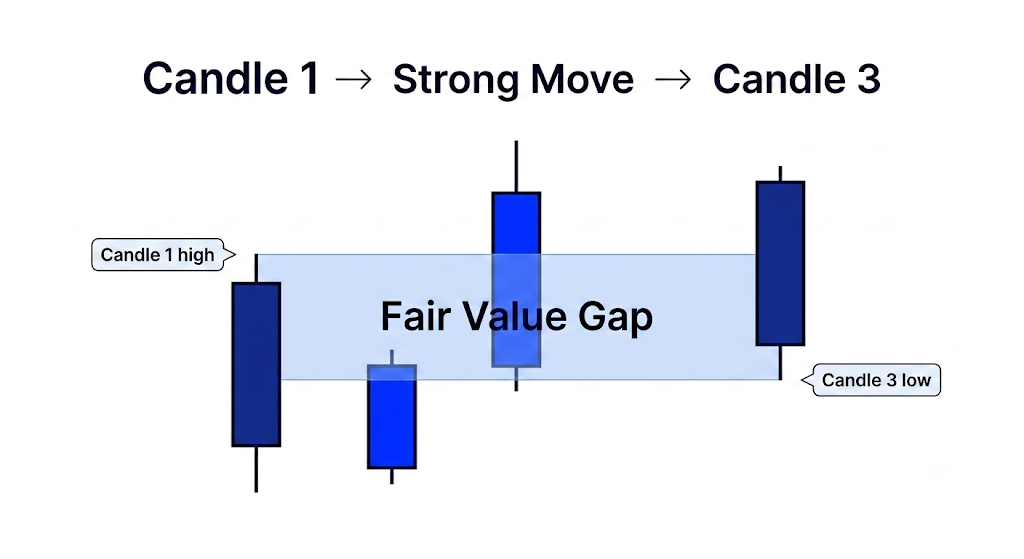
An FVG is identified using a three-candle structure on a chart:
- Bullish FVG: During a strong upward move, the highest price of Candle 1 remains below the lowest price of Candle 3, creating a gap between them.
- Bearish FVG: During a strong downward move, the lowest price of Candle 1 remains above the highest price of Candle 3, creating a gap between them.
- Standard definition: An FVG is generally considered valid when Candle 1 and Candle 3 do not overlap in price.
This three-candle structure can be identified on different chart intervals, from short-term to long-term charts. However, gaps formed on higher timeframes (such as 1-hour or daily charts) tend to reflect broader market activity and are generally more meaningful, while lower-timeframe (such as 1-minute or 5-minute charts) gaps can form more frequently and may be less reliable due to short-term price noise.
Consequent Encroachment (CE)
The midpoint of a Fair Value Gap divides the imbalance into two equal halves. Within Smart Money Concepts (SMC), this 50% level is called Consequent Encroachment (CE). It is treated as a sensitive reaction level and is commonly described within the SMC framework as a level that algorithmic trading systems may monitor when price revisits the imbalance. Like the Fair Value Gap itself, CE is used as a reference level rather than a guaranteed support or resistance area.
Why Fair Value Gaps Form in the Market?
Fair Value Gaps form when price moves rapidly in one direction, leaving little or no trading between certain price levels. This typically happens when strong buying or selling activity moves through available orders quickly, allowing price to advance or decline with little trading at certain price levels.
According to Smart Money Concepts (SMC) methodology, these inefficiencies can become areas that price may revisit before continuing its original direction or changing course. While this behavior is a core principle of the FVG framework, it is not guaranteed to occur every time.
Within this framework, the process is commonly described as:
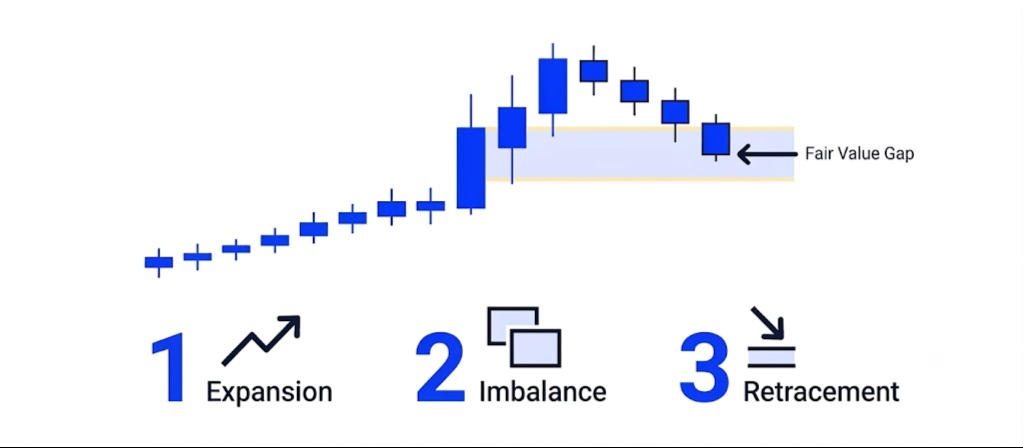
Expansion → Imbalance → Retracement
- Expansion: A strong directional move creates the gap.
- Imbalance: The rapid move leaves an area where little trading occurs.
- Retracement: Price returns to the imbalance zone before potentially continuing or reversing.
Why Traders use Fair Value Gaps?
Traders use Fair Value Gaps to identify areas where price may deserve closer attention rather than to predict future market direction. An FVG provides a structured reference zone that can be evaluated alongside trend, market structure, and other technical analysis concepts before making a trading decision.
In practical use, FVGs are applied for:
- Entry planning during retracements
- Defining zones of interest within trends
- Setting logical targets based on prior inefficiency areas
Because an FVG is a reference zone and not an exact entry signal, traders often wait for additional confirmation before acting.
FVG Trading Strategies
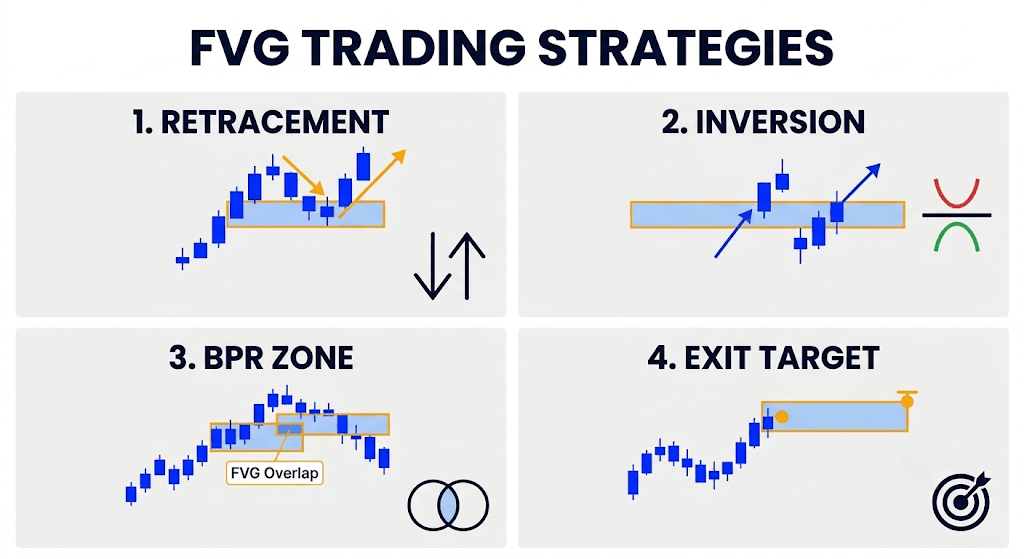
1. Classic Retracement Strategy (Trend Continuation Entry)
This strategy is used when price is moving strongly in one direction, and you want to trade in line with that momentum. A strong move creates a Fair Value Gap, and the next phase is often a retracement, or pullback against the trend, into that imbalance before continuation.
The process typically follows this structure:
- A clear directional trend is identified first.
- An impulsive move creates a Fair Value Gap.
- The imbalance zone is marked on the chart.
- Price then retraces into the Fair Value Gap.
- Traders using this approach often look to enter near the edge of the zone once price shows a reaction.
- A stop-loss is commonly placed beyond the most recent swing low for a buy trade or the most recent swing high for a sell trade.
- The previous swing high or swing low commonly serves as the profit target.
Swing highs and lows are points on the chart where price reversed direction, such as the highest point before price turned down or the lowest point before price turned up. If price continues moving without returning to the FVG, the setup does not trigger, and you wait for the next valid opportunity rather than chasing the move.
Example: On a 1-hour chart, a strong upward move may create a bullish Fair Value Gap. If price later returns to that gap and shows a reaction, a trader may enter near the gap and place a stop-loss below the most recent swing low (the latest low point before price moved higher).
2. Inversion FVG Strategy (Reversal Setup)
An FVG can change roles and does not always remain fixed. When price breaks decisively through a previously valid imbalance with a large directional move that closes beyond the gap, the zone may change function. This is referred to as inversion, meaning the FVG flips from one role to another.
The structure works as follows:
- An existing Fair Value Gap is identified within the prevailing trend.
- Price then breaks and closes beyond the Fair Value Gap with a clear directional move.
- The broken Fair Value Gap becomes the new reaction zone.
- Price later retests the area from the opposite side.
- Confirmation is commonly sought before considering a reversal entry.
- A stop-loss is commonly placed beyond the most recent swing high or swing low, depending on the trade direction.
- The next swing level or liquidity area commonly serves as the profit target. (A liquidity area is where many pending buy or sell orders exist.)
In this approach, the original imbalance is generally treated as no longer acting in its original role. Instead, the broken FVG becomes a flipped reaction zone that may provide opportunities for reversal entries.
3. Balanced Price Range (BPR) Strategy
The Balanced Price Range (BPR) forms when bullish and bearish Fair Value Gaps overlap within a small number of consecutive candles. This creates a zone where buying and selling imbalances exist in the same price area.
The structure can be broken down like this:
- A bullish FVG forms during an upward move.
- Within the next few candles, a bearish FVG forms in the same price region.
- The overlapping area becomes the BPR zone.
This overlapping zone reflects a strong interaction between buyers and sellers and may become an area where price reacts when revisited.
Trading steps include:
- The overlapping Fair Value Gap area forms the Balanced Price Range zone.
- Price later returns to the Balanced Price Range zone.
- A clear reaction, such as a strong reversal candle, is commonly used as confirmation.
- A stop-loss is commonly placed just outside the BPR zone.
- The next important price level commonly serves as the profit target.
Within the Fair Value Gap methodology, BPR zones are commonly monitored during periods of larger price swings because they are more likely to form when price moves quickly in both directions.
4. FVG Target Strategy (Liquidity Draw Method)
In this approach, Fair Value Gaps are not used for entries but for defining exit targets. Larger Fair Value Gaps often represent areas that price may revisit over time.
The method works as follows:
- A larger Fair Value Gap is identified on the chart.
- The trade is initiated using another entry method, such as a breakout or moving average.
- The Fair Value Gap is used as a predefined profit target.
- Profits are commonly taken once price reaches or begins filling the Fair Value Gap.
In this approach, the FVG acts as a destination rather than a trigger. It helps define where you plan to take profits instead of where you enter the trade.
Should you use FVG trading on its own?
No, Fair Value Gap (FVG) analysis is generally used alongside other forms of technical analysis rather than as a standalone entry signal.
An FVG identifies a price imbalance zone where the market may react, but it does not show whether price will continue, reverse, or move sideways after reaching that area. For this reason, FVGs are commonly combined with the market trend, recent price direction, or a clear price reaction inside the gap, such as a strong candle moving back in the expected direction.
Before using any FVG strategy with real capital, test each approach on historical charts or in a simulated trading environment. Focus on how often price returns to the Fair Value Gap, how it reacts after reaching the zone, and whether the entry rules remain consistent across different market conditions.
How to choose the right FVG strategy?
Selecting the correct FVG approach depends on the market environment rather than the pattern itself.
| Market condition | How to recognize it | Suitable FVG strategy |
| Trending market | Price is moving steadily in one direction. | Classic Retracement Strategy |
| Reversal conditions | Price changes direction after breaking through an existing Fair Value Gap. | Inversion FVG Strategy |
| Large, fast price swings | Price moves quickly in both directions over a short period. | Balanced Price Range (BPR) Strategy |
| Planning trade exits | You want to use an existing Fair Value Gap as a profit target instead of an entry point. | FVG Target Strategy |
The structure of the market determines how the imbalance should be interpreted.
FVG trading works best when entries, risk, and strategy selection follow a clear set of rules across different market conditions. A structured evaluation environment like Apex Trader Funding lets you practice these setups in real time under predefined risk and performance rules. This helps you refine the execution of FVG strategies across different market phases with discipline and consistency.
Disclaimer: Futures trading involves substantial risk and may not be suitable for every trader. No trading strategy, including Fair Value Gap (FVG) analysis, can guarantee profits or prevent losses. Past performance does not guarantee future results. Only trade with capital you can afford to lose.
FAQs:
What timeframe works best for FVG trading?
FVGs can form on any timeframe, but zones on higher timeframes (such as 1-hour or Daily charts) are generally considered more significant than those on lower timeframes (such as 1-minute or 5-minute charts), which form more frequently and are more influenced by short-term price fluctuations.
How long does an FVG zone stay valid?
An FVG zone is generally considered mitigated or filled once price returns to touch or completely trade through the gap area. Once price has filled, the zone is generally no longer considered active for that setup.
What’s the difference between an FVG and a regular price gap?
A regular price gap typically refers to a difference between one session’s closing price and the next session’s opening price. An FVG is identified within a continuous three-candle structure on a single chart, regardless of session breaks.