
Executive Summary: Day trading can work as a side hustle for traders who bring structure and consistency to their approach. Active screen time, quick decision-making, and a working knowledge of how markets move are all part of the process. Traders who treat it as a learnable skill and dedicate consistent time to it can build a legitimate source of income alongside their regular schedule.
What Is Day Trading?
Day trading is a trading style where positions are opened and closed within the same trading day, with no trades typically held overnight. The goal is to take advantage of short-term price movements in liquid markets such as Equity Futures, Metal, or Energy markets.
It focuses on intraday market activity rather than long-term Position holding, with traders reacting to price changes as they occur during active trading hours.
Because trades are executed frequently and market conditions can change quickly, day trading requires consistent attention, structured risk management, and familiarity with order execution. Many beginners start by practicing on simulated accounts to understand how price movement, volatility, and timing interact before trading with real capital.
What Makes Day Trading Appealing and Challenging as a Side Hustle?
Day trading is often seen as an accessible way to participate in financial markets, which is one of the main reasons it attracts attention as a side hustle. The ability to start with relatively small capital, use online platforms, and trade flexible hours makes it appealing to individuals who want an additional income stream alongside other commitments.
At the same time, the same features that make day trading attractive can also make it demanding in practice. Markets move quickly during active hours, requiring consistent attention, timely decision-making, and familiarity with execution mechanics. Price movements during active sessions can be fast-moving, which is why timing and preparation play a key role in trade execution.
As a result, day trading tends to sit at the intersection of flexibility and intensity. While it offers open access and schedule independence, it also requires structured focus during market hours, making it a more active and skill-dependent pursuit than many other side income activities.
Common Strategies Used in Day Trading
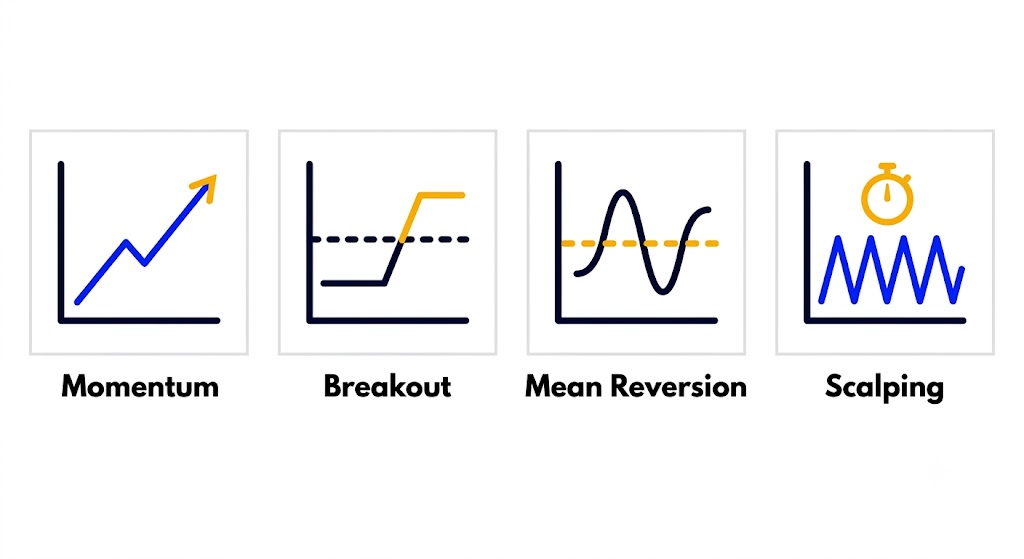
Day traders typically use structured approaches to identify short-term opportunities rather than relying on random market movement. Each strategy focuses on different types of price behavior during the trading session and is applied based on market conditions, volatility, and timing.
- Momentum Trading: This strategy focuses on assets showing strong directional movement with increasing volume. Traders aim to seek exposure during the move and exit while momentum is still active, often during high-volume market sessions. The idea is to participate in short bursts of strength rather than long trends.
- Breakout Trading: Breakout traders look for the price to move beyond established support or resistance levels (price zones where buying or selling pressure has historically stalled the market). When price breaks a key range, it can signal the start of a new short-term trend. Traders often watch for volume expansion or volatility spikes as possible evidence that the breakout has market participation.
- Mean Reversion: This approach is based on the tendency of prices to return toward an average level after moving too far in one direction. Traders look for overextended moves and then attempt to capture the pullback toward a more balanced price range.
- Scalping (optional strategy): Scalping involves taking very small price movements over short time frames, sometimes within seconds or minutes. It relies heavily on execution speed, tight risk control, and frequent trade opportunities during active market periods.
While each strategy functions differently, most day trading approaches depend on clear rules, consistency in execution, and disciplined risk management rather than predicting exact market direction.
Final Thoughts
Before placing live trades, it helps to understand how trading frequency, costs, and risk settings interact over time. Many traders start in a simulated environment to see how commissions and slippage affect results, then refine their approach by focusing on fewer, higher-quality setups per session with consistent position sizing.
Day trading takes structure and patience. A clearly defined approach built through practice and observation gives traders a reliable foundation when they move into live trading.
Disclaimer: Trading involves substantial risk and is not suitable for every trader. Past performance does not guarantee future results. This article is for educational purposes only and does not constitute financial, investment, or trading advice.