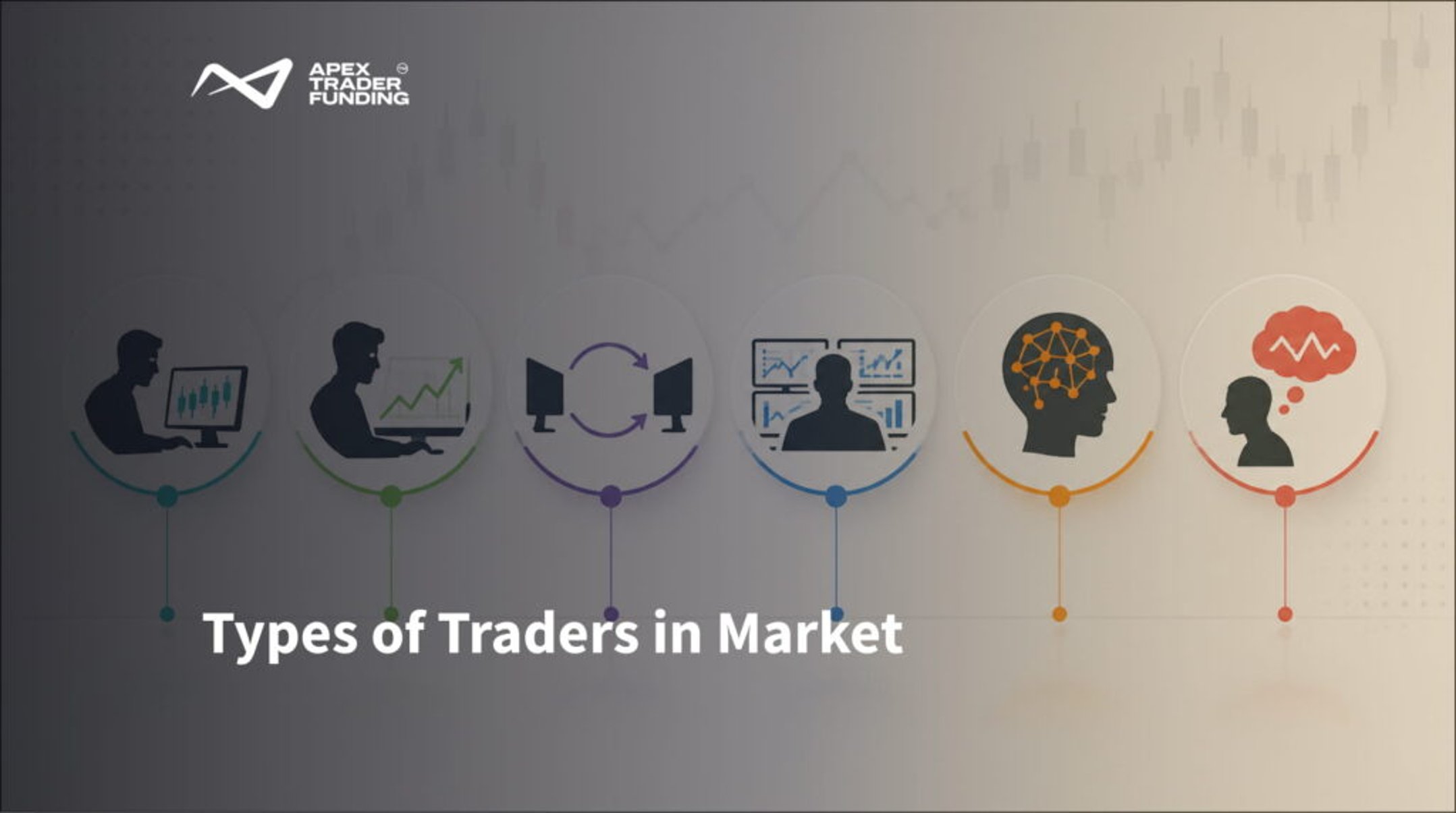
Executive Summary: Traders can be classified by holding period, strategy, funding model, execution method, and behavior. Common profiles include scalpers, swing traders, arbitrageurs, prop traders, quantitative traders, and noise traders. Each profile uses different approaches to market analysis, trade execution, and risk management.
Why Does Understanding Trader Types Matter?
Understanding trader types helps explain why market participants respond differently to the same price movement. Each approach has its own time horizon, execution requirements, capital needs, and risk exposure. Identifying these differences allows traders to select methods that match their available time, experience, and tolerance for loss.
Three market factors influence how these profiles operate:
- Order flow: The stream of buy and sell orders entering a market.
- Liquidity: The ability to execute an order without causing a significant price change.
- Volatility: The speed and extent of price movement during a given period.
Different trader types clarify how different participants approach decision-making, manage risk, and structure their trading process. A single market movement can lead to very different actions depending on a trader’s objectives.
For example, two individuals may observe the same price movement in a market. One may decide to act immediately based on a short-term reaction, while the other may wait for additional confirmation before making a decision. Even though the information is identical, their actions differ because their goals, time horizon, and decision rules are not the same. As a result, the way a person responds to market changes depends on their process and risk preferences.
Trader types fall into two distinct dimensions: Execution Mechanics (Scalper, Swing, Arbitrage, Quantitative) and Capital/Behavioral Frameworks (Prop, Noise). These categories can overlap—a prop trader, for example, may use scalping, swing trading, arbitrage, or quantitative methods.
What Separates the Six Types of Traders
Each profile can be understood by examining what the trader does, how opportunities are identified, and which discipline area most affects execution.
1. Scalpers
Scalpers attempt to capture small price movements through frequent, short-duration trades. Positions may remain open for seconds or minutes, and traders usually close them within the same session. Because the expected movement on each trade is limited, execution speed and transaction costs can materially affect results.
What scalpers do:
- Monitor price, liquidity, order flow, and Level 2 Depth of Market (DOM) data (If trading Futures) for brief inefficiencies. Some scalpers also monitor Order Flow Delta, which compares aggressive buying and selling activity.
- Execute frequent entries and exits during active market sessions.
- Use predefined stops and targets to control each trade.
- Avoid holding positions longer than the strategy permits.
Platforms such as NinjaTrader provide order-entry and market-analysis tools that may support short-duration strategies.
Key discipline area: Scalpers must control trading costs, slippage (difference between expected and execution price), position size, and the frequency of execution. The Bid-Ask Spread, or difference between the highest bid and lowest ask, can represent a high cost when trades target small price movements. A strategy that appears profitable before commissions and fees may perform differently after those costs are included. Rapid trading can also make it easier to continue after the setup quality has declined, so entry criteria and session limits should be defined in advance.
2. Swing Traders
Swing traders hold positions for several days or weeks to participate in a broader price movement. They may use technical analysis, fundamental developments, market trends, or a combination of factors to determine when to enter and exit. Charting and order-management platforms such as MetaTrader 5 can be used to monitor positions across multiple sessions, depending on broker and market availability. Multi-asset brokers such as Interactive Brokers may also support swing strategies across different instruments and markets.
What swing traders do:
- Identify price movements that may develop across multiple sessions.
- Hold positions through normal intraday fluctuations.
- Use wider stops and smaller position sizes when the strategy requires more room.
- Review market events that may affect an open position.
Key discipline area: Swing traders must manage overnight and event risk. Holding a position beyond the current session may introduce price gaps, financing costs, rollover effects (costs or adjustments that occur when a position is carried into the next trading period), or additional margin requirements, depending on the instrument, including leveraged markets such as CME Futures. Margin is the amount of capital required to open and maintain a leveraged position in a brokerage account. Traders also need to consider whether multiple positions are affected by the same market driver, meaning different trades may move in the same direction at the same time during volatile conditions.
3. Arbitrageurs
Arbitrageurs aim to profit from temporary price differences between related markets or instruments by quickly taking opposite positions, such as buying one asset while simultaneously selling a closely related asset to lock in the price gap. The focus is on capturing pricing inefficiencies rather than predicting overall market direction. Statistical Arbitrage applies quantitative methods to identify and trade temporary deviations from historically observed relationships.
What arbitrageurs do:
- Compare prices across related instruments, contracts, or venues.
- Identify discrepancies large enough to cover fees and execution costs.
- Attempt to execute opposite positions within a limited period to profit from the price difference.
- Close the positions when the pricing relationship returns to the expected range.
Key discipline area: One challenge in arbitrage is that both sides of a trade may not execute at the same time, which can leave temporary exposure to price movement. Liquidity can change quickly, and related instruments may not always move in sync. Price differences may also last longer than expected or require more capital than planned. For this reason, accurate data and fast execution are important, as pricing gaps can disappear before both positions are fully in place. Institutional systems may use the FIX Protocol to exchange standardized order and execution messages between trading venues and financial platforms. Traders also need to estimate costs in advance and plan for situations where only part of the trade is filled.
4. Prop Traders
A prop trader operates within a firm’s capital framework and risk rules. Depending on the firm and program stage, trading may take place in a simulated evaluation, a simulated funded account, or a live proprietary account. Prop trading therefore describes the account and funding structure rather than a specific trading strategy.
A prop trader may also be a scalper, swing trader, or systematic trader. The permitted approach depends on the markets offered and the rules established by the firm.
What prop traders do:
- Complete an evaluation or qualification process when required.
- Meet the firm’s eligibility and payout conditions.
- Trade according to the firm’s permitted markets and account conditions.
- Follow drawdown (maximum loss from peak equity), position-size, and loss-limit rules.
Key discipline area: Prop traders must understand the program’s risk limits, drawdown methods, such as End-of-Day (EOD) and Intraday drawdown, and payout requirements. These rules define how much risk the trader can take and when account access may be restricted. An Unrealized Trailing Drawdown may move with open-trade equity, causing the loss threshold to adjust before a position is closed. Following these rules consistently helps traders avoid exceeding program limits. The classification and consequences of a breach, including whether trading is paused or account access is affected, vary by firm and program.
5. Quantitative Traders
Quantitative traders use mathematical models, historical data, and predefined rules to identify or execute trades. Some systems operate automatically, while others generate signals that a trader reviews before placing an order. The method can be applied to both short- and long-term strategies.
What quantitative traders do:
- Convert a trading idea into measurable rules.
- Test the rules against historical and current market data.
- Monitor execution, transaction costs, and model performance to ensure the strategy behaves as expected in live conditions.
- Review risk-adjusted measures such as the Sharpe Ratio, which compares return with return variability.
- Adjust or retire a strategy when its underlying assumptions (e.g., market behavior, liquidity, or cost stability) no longer hold.
Key discipline area: Quantitative traders must distinguish between a promising historical test and a strategy that can operate under live conditions. Poor data, Backtesting Overfitting, unrealistic transaction-cost assumptions, or execution delays can make backtested results difficult to reproduce.
A quantitative strategy can also lose effectiveness when market relationships change or increased competition reduces the opportunity it was designed to capture. The first problem may indicate model drift. The second is commonly described as strategy crowding or alpha decay (decline in excess returns as a strategy becomes widely used).
Systematic execution can reduce some impulsive decisions, but it does not eliminate human judgment. People still select the data, design the model, choose risk limits, and decide when the system should be changed or stopped.
6. Noise Traders
Noise trading is a behavioral pattern in which decisions are driven by urgency, excitement, fear, attention, recent price movement, or unverified and incomplete information rather than a defined process. It is not usually a deliberate trading method, and any trader can display this behavior regardless of account type or strategy.
What noise trading may look like:
- Entering after excitement has already pushed a price higher.
- Exiting after fear has accelerated a decline.
- Acting on an unverified headline or social-media post.
- Changing direction repeatedly without new supporting evidence.
- Placing trades without predefined entry, exit, or risk conditions.
Key discipline area: Noise traders may trade without evaluating whether the price, timing, and risk still support the decision. A profitable outcome does not necessarily validate the process, just as a planned trade is not automatically incorrect because it loses.
The practical response is to define the conditions that must exist before a trade is placed. Recording the reason for entry, the permitted risk, and the planned exit makes it easier to determine whether a decision followed a repeatable method or reacted to short-term market noise.
How the Six Trader Profiles Compare
The six profiles differ in holding period, primary approach, capital source, and risk. Because the categories describe different aspects of trading, one person may combine several of them.
| Trader profile | Typical holding period | Primary approach | Possible capital source | Main risk |
| Scalper | Seconds to minutes | Captures small, short-term price movements | Personal or firm-controlled capital | Costs, slippage, and rapid losses |
| Swing trader | Several days to weeks | Trades broader price movements | Personal or firm-controlled capital | Overnight gaps and changing market conditions |
| Arbitrageur | Seconds to several days | Trades temporary price differences | Personal or institutional capital | Execution, liquidity, and basis risk (unexpected changes in the price relationship between hedging assets) |
| Prop trader | Varies by strategy and program | Trades within a firm’s capital framework | Simulated or live firm account, depending on the program | Violating drawdown or account rules |
| Quantitative trader | Milliseconds to months | Uses mathematical and rule-based models | Personal, firm, or institutional capital | Model failure, data errors, and strategy decay |
| Noise trader | Varies | Responds to sentiment, attention, or incomplete information | Any capital source | Poor timing and inconsistent risk decisions |
The holding periods in this table are general ranges rather than fixed rules. A quantitative strategy may operate over milliseconds or several months, while a prop trader’s holding period depends on both the strategy and the program’s restrictions.
How Can Traders Identify Their Primary Profile?
A trader can identify their primary profile by examining actual holding periods, decision rules, execution frequency, capital structure, and risk exposure. The profile should reflect how trades are managed in practice rather than how the trader intends to operate.
The following comparison can help narrow the choice:
| If the trader needs | Profile to consider | Main requirement |
| Frequent short-duration trades | Scalping | Fast execution and strict cost control |
| Multi-day market exposure | Swing trading | Overnight risk and correlation management |
| Price-discrepancy strategies | Arbitrage | Reliable execution across venues or instruments |
| A structured firm program | Prop trading | Compliance with drawdown and account rules |
| Systematic execution at scale | Quantitative trading | Programming, testing, and model oversight |
Several practical questions can help clarify the most suitable approach:
- How much time is available?
Scalping may require sustained attention during a live session. Swing trading usually involves fewer decisions but exposes the position to overnight developments. - How quickly must orders be executed?
Arbitrage and some scalping methods may depend heavily on execution speed and liquidity. Slower strategies may allow more time for analysis. - What capital structure is being used?
A personal brokerage account and a prop evaluation apply different financial arrangements and risk rules. Traders should understand what happens when a loss threshold is reached. - Is the method discretionary or systematic?
A discretionary trader makes decisions by interpreting current conditions, while a systematic trader follows predefined rules. Many approaches combine both methods. - Which risk is most difficult to manage?
A trader may struggle with frequent decision-making, overnight exposure, execution uncertainty, model reliability, or compliance with account rules. The selected approach should include controls for its most important risk.
The purpose is not to assign a permanent label. It is to identify the current method clearly enough to choose suitable tools, expectations, and risk controls.
Final Thoughts
Clarity about your approach before a session opens determines whether you’re executing a plan or reacting to one. The trader who can answer “what am I doing and why?” before placing an order is already operating at a different level. Staying within your defined risk parameters is what separates sustainable trading from guesswork.
If you are a prop trader or want to discover your type of trader in a structured environment, you can review Apex Trader Funding’s evaluation options and current risk rules to determine which framework aligns with your trading plan and risk limits.