
Executive Summary: The 5 best trading psychology books for beginners are Mark Douglas’s Trading in the Zone (probability thinking), Douglas’s The Disciplined Trader (rules and discipline), Brett Steenbarger’s The Daily Trading Coach (self-coaching routines), Tom Hougaard’s Best Loser Wins (managing losses), and Van K. Tharp’s Trading Beyond the Matrix (risk beliefs). Together, they help traders reduce and manage revenge trading, hesitation, and emotional rule-breaking.
Why Trading Psychology Matters as Much as Strategy?
A trading strategy defines when to enter, how much to risk, and when to exit. Trading psychology affects whether those rules are followed when real money, uncertainty, and rapidly changing prices affect emotions and decision-making.
Psychology is not about eliminating emotion. Fear, frustration, excitement, and overconfidence can still appear during a trading session. The practical objective is to prevent those emotions from repeatedly changing position size, entry standards, stop placement, or exit decisions.
A gap often develops between a strategy’s tested results and its live execution. Common errors include premature entries, hesitation, revenge trading, altered stops, premature exits, and trading beyond session limits.
Over a series of trades, such errors can change a strategy’s expected performance. The key question is not whether one trade produces a profit or loss, but whether execution consistently follows the predefined rules. A profitable impulsive trade does not necessarily represent good execution, just as a planned losing trade does not automatically represent poor execution.
Trading psychology books help traders identify these behavioral patterns and build processes for managing them. However, psychology cannot create a trading advantage where none exists. A trader still needs a tested strategy, suitable risk controls, sufficient capital, and realistic expectations.
The Five Books at a Glance
Each book approaches trading psychology from a different angle. The best choice depends on the specific behavior or performance problem the trader needs to address.
| Book | Author | Core focus | Best for | Important consideration |
| Trading in the Zone | Mark Douglas | Probability-based thinking | Traders attached to individual outcomes | Conceptual and best supported by active journaling |
| The Disciplined Trader | Mark Douglas | Foundations of self-discipline | Complete beginners | Some market references may feel dated |
| The Daily Trading Coach | Brett Steenbarger | Structured self-coaching | Process-oriented traders | Requires consistent daily application |
| Best Loser Wins | Tom Hougaard | Responding constructively to losses | Traders struggling with revenge trading | Provides less detail on complete risk-management systems |
| Trading Beyond the Matrix | Van K. Tharp | Beliefs and performance patterns | Analytical, self-directed traders | Requires deeper personal assessment |
A Closer Look at the Five Best Trading Psychology Books
1. Trading in the Zone
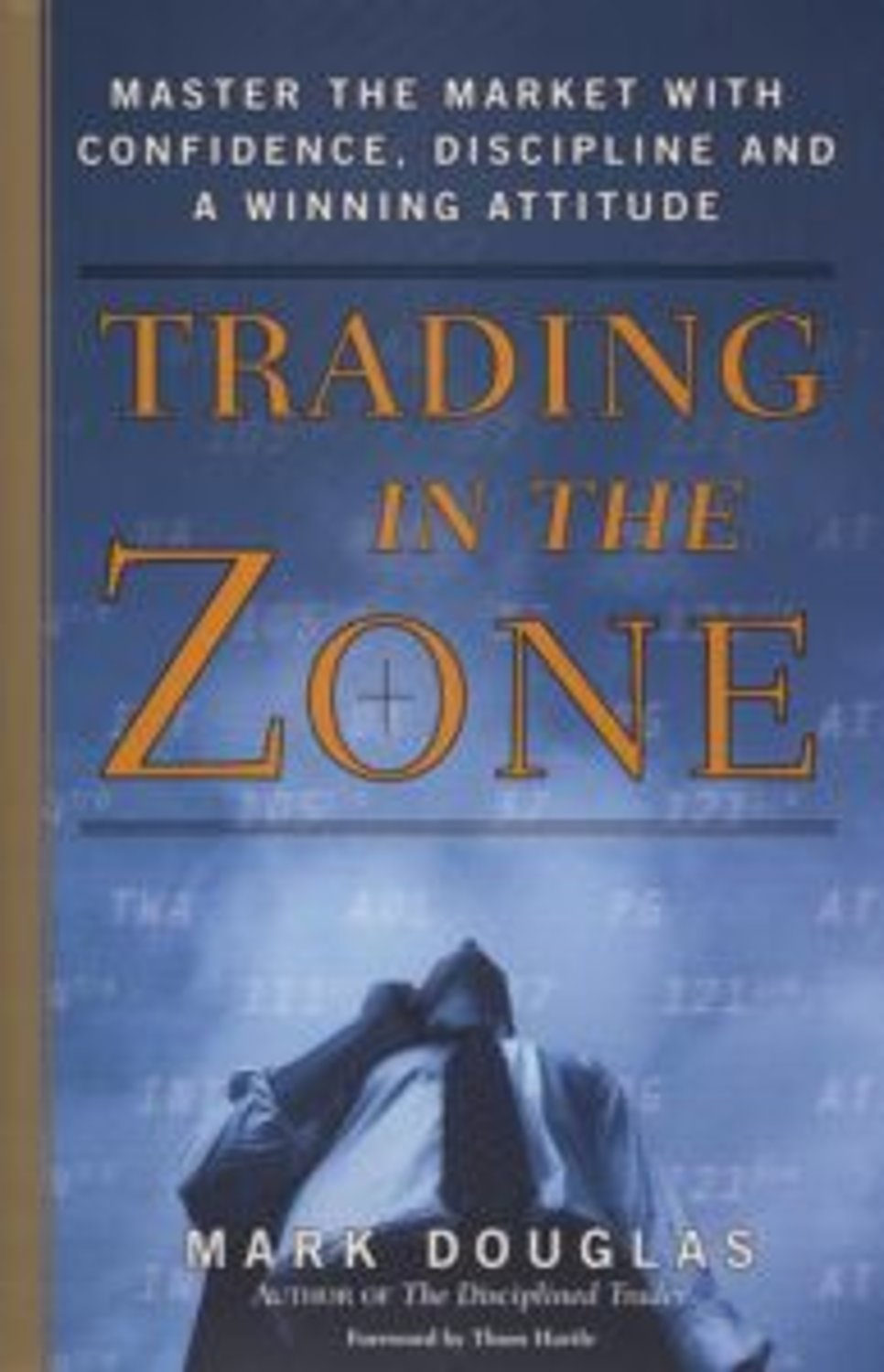
Mark Douglas’s Trading in the Zone explains why traders can understand a strategy intellectually and still struggle to execute it consistently. Its central focus is the uncertainty of individual trade outcomes and the need to think in probabilities across a series of trades.
Understanding the uncertainty in trading can reduce the pressure to predict every move correctly and redirect attention toward executing the same process across a meaningful sample of trades. For example, a trader may experience a click delay (the psychological hesitation or paralysis a trader experiences right before entering an order) when a valid setup appears. This hesitation may reflect Loss Aversion, the tendency to feel the impact of a loss more strongly than an equivalent gain. Accepting losses as part of the strategy allows decisions to be based on plan compliance rather than certainty and helps limit Outcome Bias, which occurs when decision quality is judged only by whether a trade wins or loses.
A practical way is to record whether each trade met the predefined entry, position-size, and exit rules, and then evaluate execution across a series of trades rather than using a single outcome to judge the entire strategy.
- Best for: Traders who hesitate at entry, become emotionally attached to individual positions, or expect each valid setup to produce a specific result.
- Important limitation: The book is conceptual. It explains how traders can think about uncertainty, but it does not provide a complete daily coaching routine or a detailed risk-management system. Its ideas are most useful when combined with journaling and clearly defined trading rules.
- Practical workaround: Pair the book’s probability-based mindset with a predefined risk-per-trade limit—such as 1% of the account balance—and a trading journal that records whether each entry, position size, and exit followed the written plan.
2. The Disciplined Trader
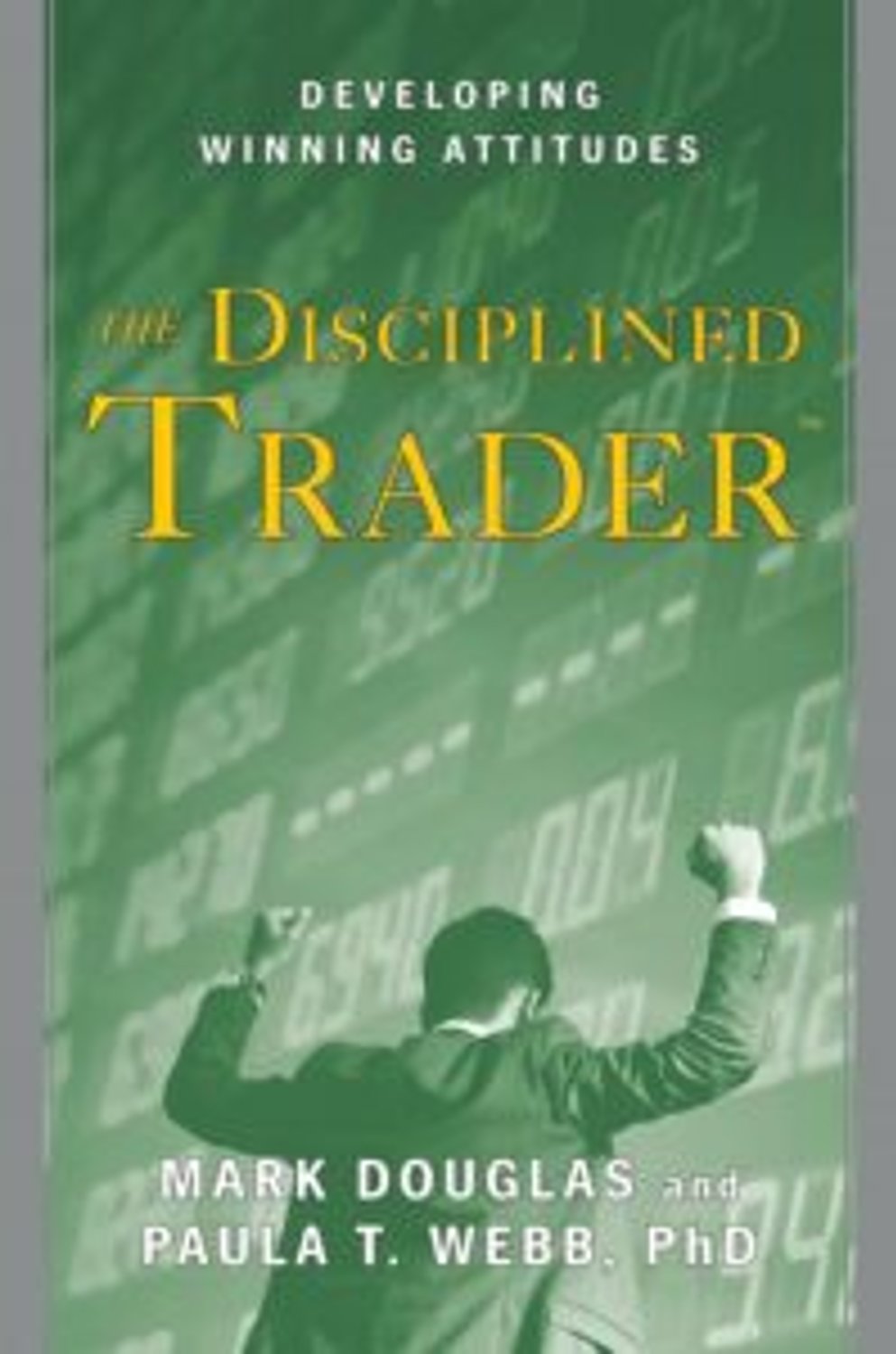
The Disciplined Trader is Mark Douglas’s earlier examination of the unique behavioral challenges financial markets pose. It focuses on the need for traders to establish internal boundaries in an environment that does not automatically restrict impulsive decisions.
Markets do not prevent traders from entering weak setups, increasing risk, or continuing after a series of losses. A trader must create and enforce those boundaries independently. In many areas of everyday life, external rules limit behavior, but trading provides far more freedom. That freedom can become a problem when decisions are driven by frustration, fear, or the desire to recover losses. The book helps explain why discipline is more than willpower and why it requires a predefined structure that determines what the trader can do before emotional pressure appears.
A practical application of this idea is to create a written trading plan that defines permitted setups, maximum position size, stop placement, session loss limits, and the conditions that require a pause. Order Management Systems (OMS) can support this structure by organizing orders and applying predefined execution controls, although the trader remains responsible for setting and following the rules.
- Best for: Complete beginners who need to understand why personal rules and risk limits must be established before trading begins.
- Important limitation: Some examples and market references reflect the period in which the book was written, when pit and floor trading played a larger role. Although market mechanics have shifted toward digital execution platforms, algorithmic trading, and high-frequency environments, the underlying psychological issues remain the same. Traders must therefore apply these principles to current instruments, platforms, and risk structures.
3. The Daily Trading Coach
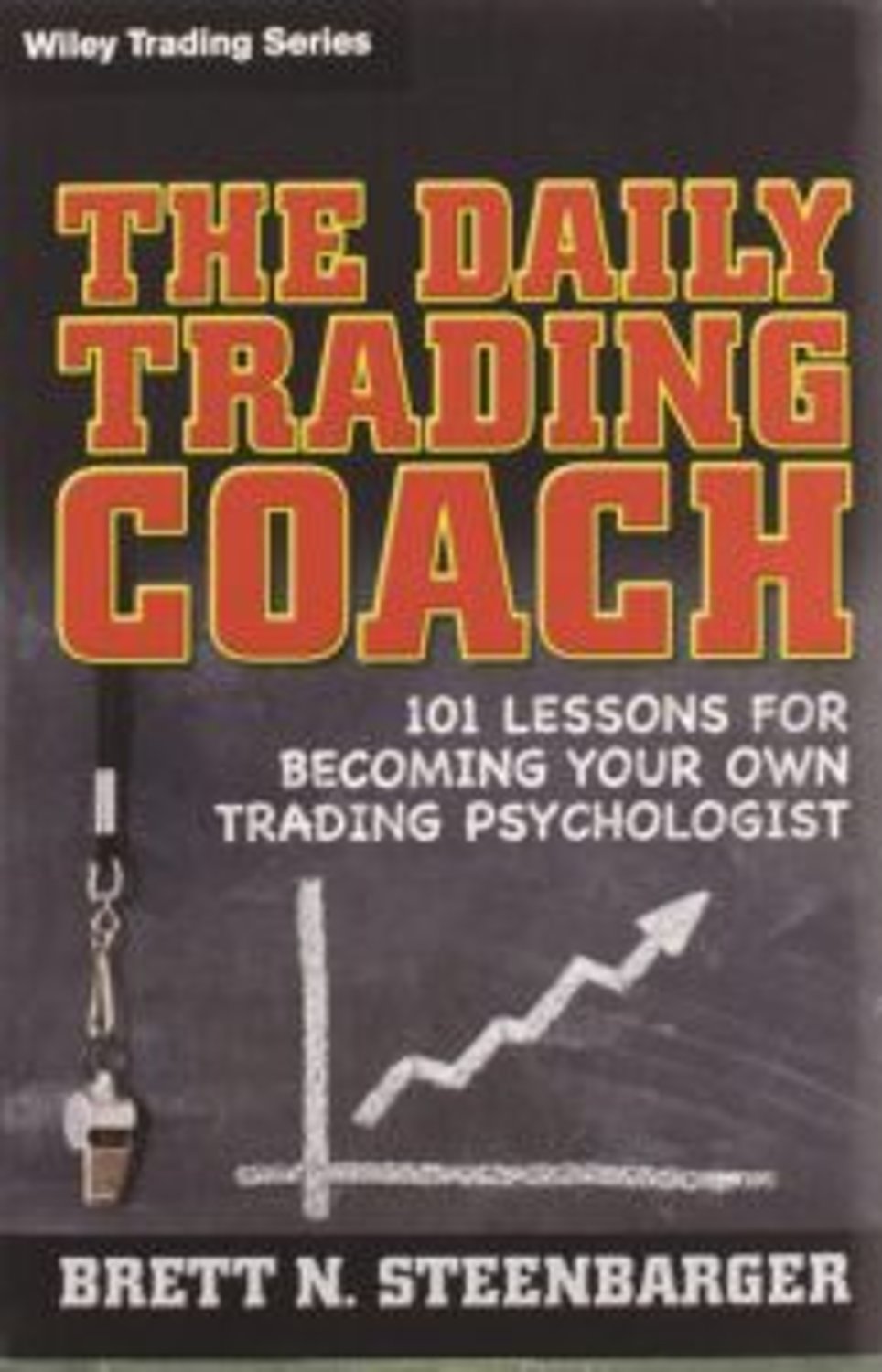
Brett Steenbarger’s The Daily Trading Coach is organized as a collection of practical lessons and self-coaching exercises. It is designed for traders who want to convert psychological observations into a repeatable improvement process.
Improvement becomes more practical when a trader identifies a specific behavior, applies a targeted exercise, and reviews the result. General instructions such as “be more disciplined” are difficult to implement without a defined action. The book examines patterns such as confirmation bias, frustration, distraction, negative self-talk, and repeated execution errors.
Confirmation bias occurs when a trader gives greater attention to evidence supporting a position while discounting information that contradicts it. Rather than treating these patterns as fixed personality traits, Steenbarger presents them as behaviors that can be observed and addressed through deliberate practice. A daily review can include:
- The strongest decision made during the session
- The clearest execution mistake
- The circumstances that preceded the mistake
- One specific behavior to repeat
- One specific behavior to correct during the next session
Digital Trading Journals, such as Edgewonk and TraderSync, can help traders record trade data, screenshots, execution notes, and recurring behavioral patterns in one organized system.
- Best for: Traders who prefer structured exercises, written reviews, measurable goals, and regular performance analysis.
- Important limitation: The book requires consistent participation. Its value comes from applying the exercises, not simply reading the lessons. Traders looking only for a short theoretical explanation may find the format more demanding.
4. Best Loser Wins
Tom Hougaard’s Best Loser Wins focuses on how traders respond to losses, uncertainty, and emotional discomfort. Its central argument is that effective trading behavior often differs from the instinctive desire to avoid pain and seek immediate reassurance.
Losses are unavoidable in trading, but the response to a loss can determine whether it remains controlled or develops into a larger behavioral problem. Revenge trading occurs when the objective shifts from taking a valid setup to recovering previously lost money, often leading to rushed entries, weaker setups, or increased position size that can compound losses before the original issue is recognized. The key idea is to separate the emotional discomfort of losing from the quality of the decision itself. Following the trading plan during a losing trade is often better execution than breaking rules to win.
The Disposition Effect, the tendency to hold losing trades too long and close winning trades too early, can create a related departure from the plan.
- Best for: Traders who struggle with revenge trading, overtrading, premature exits, or the urge to recover a loss quickly.
- Important limitation: The book is strongest on loss acceptance and behavioral response. It provides less detail on constructing a complete position-sizing or account-level risk framework, so its ideas should be applied alongside a separate written risk plan.
- Practical workaround: Use the book alongside a written risk plan that defines position-sizing limits, daily loss boundaries, and a pause condition after a loss to reduce revenge trading and unplanned risk increases.
5. Trading Beyond the Matrix
Van K. Tharp’s Trading Beyond the Matrix examines how beliefs, identity, and repeated thinking patterns can influence trading decisions. It is particularly relevant for traders who prefer deeper self-assessment rather than a simple list of behavioral rules.
Traders do not respond only to market information. They also respond to their interpretation of that information. Two traders can observe the same price movement and make different decisions because their expectations, risk tolerance, and beliefs are different.
For example, a trader may describe a position size as mathematically acceptable but repeatedly interfere with trades when normal price fluctuations occur. That behavior may indicate that the position exceeds the trader’s practical tolerance even if it remains within the written maximum. The appropriate response is not necessarily to force greater emotional control. It may be to reduce position size, revise the trading plan, or examine whether the risk assumption is realistic.
A useful application is to compare stated risk tolerance with demonstrated behavior. Traders can review whether they repeatedly move stops, exit early, avoid valid setups, or increase exposure after profitable periods. These patterns often reveal a difference between the written plan and actual tolerance in live conditions.
This review can be connected to formal position-sizing models. Fixed Fractional Sizing risks a set percentage of account equity on each trade, the Kelly Criterion estimates a theoretical allocation from the strategy’s win probability and payoff, and an R-Multiple expresses each result relative to the amount initially risked. These models provide different ways to compare stated risk limits with actual exposure and performance.
- Best for: Analytical and self-directed traders who want to examine how their assumptions about risk, control, success, and failure affect execution.
- Important limitation: The book requires considerable self-directed reflection. Its broader framework may be less accessible to traders who want a short sequence of immediately applicable daily exercises.
How to Choose the Right Trading Psychology Book?
The right starting point depends on the behavior that is currently interfering with execution. A complete beginner may need a foundation in discipline, while a more experienced trader may need help with a specific problem such as hesitation or revenge trading.
| If the trader needs… | Start with… |
| A foundation in trading discipline | The Disciplined Trader |
| Less attachment to individual trade outcomes | Trading in the Zone |
| A structured daily improvement routine | The Daily Trading Coach |
| A healthier response to losses | Best Loser Wins |
| Deeper analysis of beliefs and risk behavior | Trading Beyond the Matrix |
A beginner can consider the book that addresses the most immediate performance problem, apply its framework consistently, and evaluate whether execution improves before adding another approach.
A useful reading sequence for a complete beginner is:
- Start with The Disciplined Trader to understand why self-imposed rules are necessary.
- Read Trading in the Zone to develop probability-based thinking.
- Use The Daily Trading Coach to create a structured review routine.
- Add Best Loser Wins if loss response remains a recurring problem.
- Read Trading Beyond the Matrix when deeper beliefs or risk-tolerance patterns require examination.
This sequence is not mandatory. Traders who already follow a structured plan but struggle after losing trades may benefit more from starting with Hougaard. Process-oriented traders who understand the basic theory but lack a daily improvement method may prefer Steenbarger.
Final Thoughts
The most effective trading psychology book is the one that directly targets the specific breakdown in a trader’s execution, whether that is hesitation, overtrading, or poor loss management. Each of the five books approaches discipline from a different angle, but their real value only emerges when a trader applies one idea at a time and observes how it changes live decision-making rather than reading them as theory.
Once those psychological principles are translated into consistent behavior, the next step is to test them in a structured environment where rules, risk limits, and accountability are clearly defined. This is where a prop firm framework like Apex Trader Funding becomes relevant, as it allows traders to measure whether their improved discipline can hold up under real evaluation conditions while still operating within predefined risk parameters.
Disclaimer: Day Trading involves substantial risk and may not be suitable for every trader. Psychological preparation and risk controls cannot eliminate losses or guarantee future results. Traders should assess their financial circumstances and review all applicable account rules before participating.
Frequently Asked Questions
Is Trading in the Zone suitable for beginners?
Yes. Trading in the Zone explains probability, uncertainty, and emotional attachment in accessible language. However, complete beginners may benefit from reading The Disciplined Trader first because it provides a more foundational explanation of why trading rules are necessary.
How long should a trader apply one book’s framework?
A trader should apply the selected exercises across enough sessions to identify repeated patterns. Thirty trading sessions can serve as a practical review period, but it is an example rather than a universal requirement. The appropriate period depends on trading frequency and the behavior being measured.
Should traders read all five books?
Not necessarily. Reading several books without applying their lessons can create more information without improving execution. It is usually more effective to select one book, implement one or two relevant exercises, review the results, and then add another framework only when a different performance gap becomes clear.