
Executive Summary: Proprietary trading (prop trading) occurs when a financial firm invests its own capital for direct market gain rather than earning commissions by managing client funds. Traditional prop firms hire salaried traders to trade live capital, whereas retail prop programs evaluate independent traders via fee-based simulated accounts subject to strict drawdown rules.
What Is Proprietary Trading?
Proprietary trading, commonly called prop trading, occurs when a company trades U.S. equities, CME Futures such as the ES and NQ, Spot Forex, Commodities, or other financial instruments using its own capital. In this model, the firm assumes the trading risk rather than managing client funds and retains a share of any resulting profits.
A proprietary trading firm may support traders through:
- Trading capital or a program-defined account size
- Market data and execution platforms
- Research and analytical tools
- Risk-management systems
- Training and performance reviews
- Salary, bonuses, profit sharing, or program-defined payouts
The exact structure depends on the type of firm.
Prop trading operations generally involve trader selection, account access, execution infrastructure, risk monitoring, and performance-based compensation. Firms may recruit traders directly or require participants to complete a rule-based evaluation before receiving access to another account stage.
Account activity may occur through live brokerage accounts or simulated environments using live market data. Performance accounts operate either in a simulated environment using live market data (where payouts are funded by the firm’s balance sheet) or via direct live execution in a regulated brokerage account.
Depending on the provider and market, traders may use platforms such as NinjaTrader, Tradovate, TradingView, or MetaTrader 4/5 (MT4/MT5). Some futures programs also connect through Rithmic for market data and order routing, but platform and feed availability varies by firm and account stage.
When live US futures brokerage activity is involved, the relevant broker or intermediary may fall under Commodity Futures Trading Commission (CFTC) oversight and National Futures Association (NFA) membership requirements. These designations should be verified separately because a simulated evaluation provider is not automatically a registered broker or NFA member.
Traditional Prop Firms vs. Retail Evaluation Programs
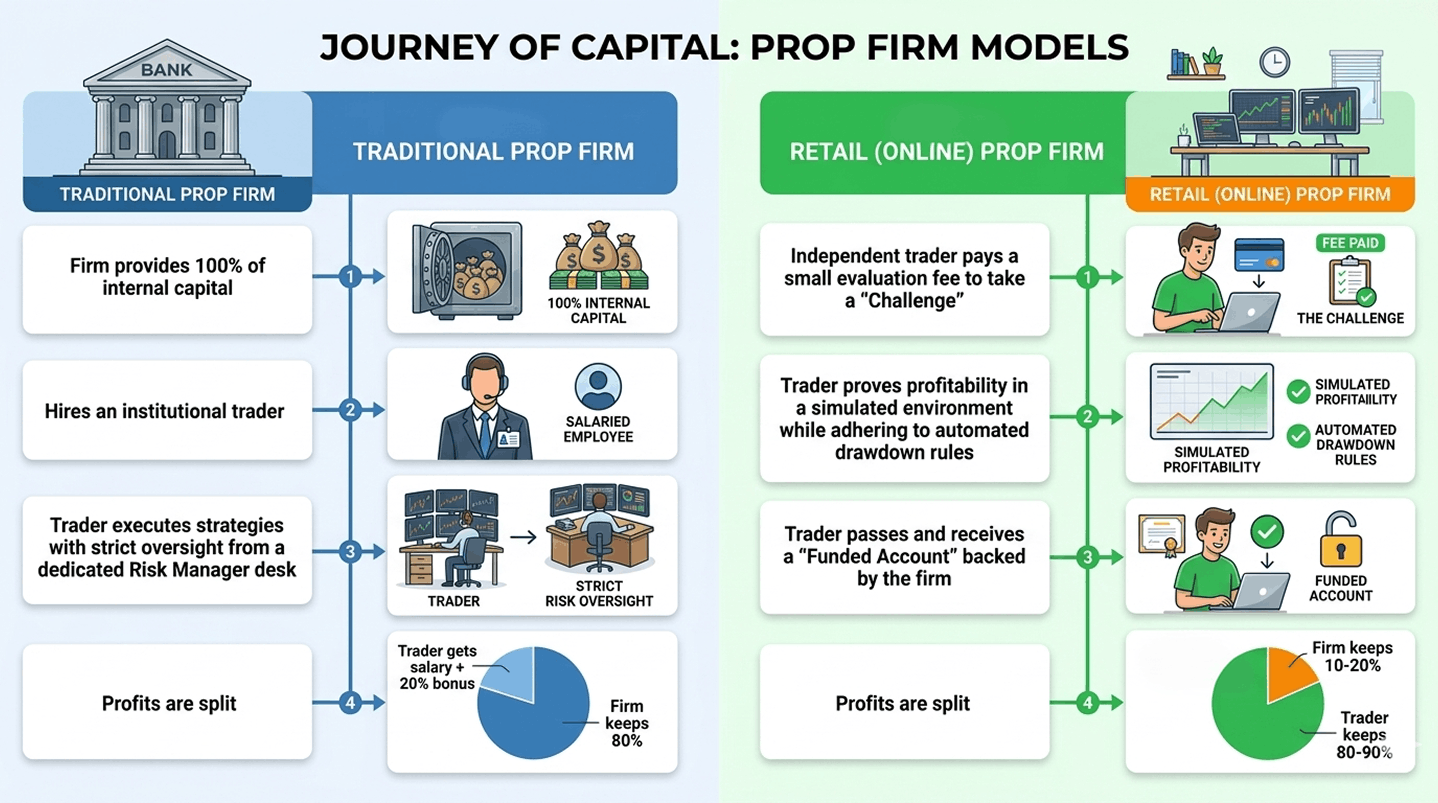
Traditional prop firms and retail evaluation programs are related to proprietary trading, but they are not the same business model.
| Feature | Traditional proprietary firm | Retail evaluation program |
| Typical participant | Employee or contracted professional trader | Independent participant who purchases an evaluation |
| Selection process | Interviews, trading records, technical tests, or professional experience | Rule-based trading evaluation |
| Trading environment | Usually live firm-operated accounts | Commonly simulated during evaluation and performance stages |
| Capital | Firm capital allocated under internal limits | Simulated balance (e.g., $50,000 to $150,000) that functions as a risk limit parameter rather than cash equity |
| Supervision | Risk managers, desk leaders, compliance teams, and automated controls | Platform rules, automated thresholds, account reviews, and provider policies |
| Compensation | Salary, bonus, profit share, or a combination | Program-defined profit sharing payouts or cash rewards |
| Participant costs | Usually limited because the firm recruits the trader | May include evaluation, activation, data, or related fees |
| Main objective | Generate returns within the firm’s risk framework | Meet evaluation and payout requirements while following program rules |
Beyond trading results, selection and account reviews may consider research ability, market knowledge, technical skill, communication, trading behavior, and compliance with risk controls.
Program rules may establish profit objectives, loss thresholds, permitted instruments, timing restrictions, and payout eligibility conditions. These requirements determine how an account can be traded and when performance becomes eligible for review or withdrawal.
The account designation should also be verified. A retail account described as “funded” may still be simulated. The displayed account size functions as a risk parameter rather than cash equity. It defines the trading rules, not necessarily live capital placed at risk in the market.
For example, Apex Trader Funding describes its End-of-Day Performance Account as a simulated funded account issued after a participant passes an evaluation. A possible transition to a live program is a separate stage.
How Prop Trading Programs Work?
Traditional proprietary firms recruit traders based on experience or demonstrated skill and then allocate firm capital for them to trade under internal risk controls. These traders operate in a professional environment with oversight from risk teams, and compensation is typically tied to performance through salary, bonuses, or profit sharing.
The retail evaluation process requires traders to first meet predefined trading rules. Successful participants may then access a performance account with similar constraints, where payouts are based on meeting ongoing performance and risk requirements. Passing the evaluation does not guarantee funding or earnings, and continued eligibility depends on consistent rule compliance.
How Do Prop Firms Control Risk?
Prop trading firms—especially retail evaluation programs—do not just judge profitability. They primarily judge how a trader manages risk under strict account constraints. This is why most programs are built around predefined loss-control mechanisms that determine whether a trader is allowed to continue, scale, or get paid.
In traditional firms, risk desks and supervisors can step in directly, adjusting exposure, trimming position size, or hedging in real time as conditions change. These firms may also use statistical models, portfolio-level limits, and automated hedging systems, but they generally allow more discretionary intervention (human judgment overriding predefined trading rules) compared to retail evaluation programs.
Retail prop programs enforce risk automatically through account rules that are strictly coded into the platform. These rules are what most traders encounter as drawdowns and loss limits.
The most important concept across all prop models is the drawdown, which represents the maximum amount an account is allowed to decline from a reference point. Some drawdowns are fixed, while others “trail” the account as it grows.
A Static Drawdown stays fixed regardless of profit. An Intraday Peak Trailing Drawdown moves upward as the account reaches new highs, effectively locking in gains and tightening the risk buffer as performance improves. This is common in retail programs, where firms want to protect simulated or allocated capital while rewarding consistency. A daily loss limit, on the other hand, is a short-term restriction that prevents excessive losses within a single trading session, regardless of overall account performance.
Max Position Limits define the largest permitted position, while exposure caps control the total market risk allowed across all open positions. Together, these rules help prevent a trader from taking more risk than the account can support.
In practice, these mechanisms work as a layered system:
- Drawdowns protect the overall account balance
- Trailing rules adjust risk as the account grows
- Daily loss limits control short-term volatility
- Position limits control trade-level exposure
Understanding how these rules interact is essential because evaluation breaches are commonly linked to automated drawdown triggers, such as trailing intraday drawdowns, rather than strategy performance alone.
Final Thoughts
Prop trading is best understood by focusing on the incentives and capital structure behind each model. Traditional firms allocate real firm capital to selected traders under active risk oversight, while retail evaluation programs primarily gate access through rule-based performance tests that may occur in simulated environments before any potential payout or capital allocation.
While both paths require strong discipline, risk control, and consistency, the key difference lies in the capital and the trader’s relationship with the firm. Prop firms like Apex Trader Funding operate within the retail model, offering structured evaluation-based accounts with defined risk parameters and progression rules that traders must follow to qualify for performance opportunities.
Disclaimer: Proprietary trading involves substantial risk and may not be suitable for every trader. Evaluations, simulated accounts, risk controls, and educational materials cannot eliminate losses or guarantee payouts. Traders should assess their financial circumstances before participating.
FAQs
Is prop trading legal?
Yes. Proprietary trading is a recognized business activity, but the legal and regulatory requirements depend on the firm, location, instruments, and operating structure. A retail evaluation provider should not automatically be treated as a registered broker, investment adviser, or traditional employer. You should review the provider’s legal disclosures and contracts before participating.
Do prop firms always provide live capital?
No. Traditional firms commonly trade live firm capital, but many retail evaluation and performance accounts are simulated. A trader may receive program-defined payouts based on simulated results without placing trades directly into a live market account.
What happens after a trader passes an evaluation?
The trader may become eligible to activate a performance account. That account can have different rules from the evaluation, including consistency requirements (limits on how much one trading day can contribute to total profits), payout conditions, scaling limits, and additional compliance reviews.
Is prop trading suitable for beginners?
A structured program can help a beginner understand risk limits, but it does not replace basic trading education or a tested strategy. Before purchasing an evaluation, a beginner should understand order types, position sizing, stop placement, drawdown, trading costs, and the rules of the selected program.