

Executive Summary: No. NinjaTrader is not a proprietary trading firm. It is a software developer and NFA-regulated Futures Commission Merchant (FCM). Traders must fund NinjaTrader brokerage accounts with their own capital. However, independent futures prop firms frequently license NinjaTrader as their execution interface for evaluation and funded accounts.
What is NinjaTrader?
NinjaTrader is frequently mentioned in futures prop trading because many traders use its software to access evaluation or funded accounts. However, providing the trading platform does not make NinjaTrader the company operating the prop program.
NinjaTrader has two primary roles:
- Trading platform: Provides software for market analysis, charting, indicators, order management, and trade execution.
- Futures brokerage: Allows customers to deposit personal capital and trade futures through a brokerage account.
NinjaTrader’s brokerage operates as a Futures Commission Merchant (FCM) (a regulated entity authorized to hold customer funds and facilitate futures trades). It is regulated by the Commodity Futures Trading Commission (CFTC) and is a member of the National Futures Association under NFA ID 0309379.
How does NinjaTrader differ from a Prop Firm?
The core difference is capital ownership: In a NinjaTrader brokerage account, you provide the trading capital and retain the profits after applicable costs. In a prop firm, you trade under the firm’s account model after passing a paid evaluation, with eligible profits typically shared under an 80%–100% trader payout model.
NinjaTrader provides the tools to execute trades, but the capital in a standard brokerage account is entirely yours. If a trader uses NinjaTrader for a personal brokerage account, they must manage intraday margins. This is the broker-set margin requirement for maintaining a futures position during the trading session. It is typically lower than the margin requirement for holding the position overnight, which applies outside the broker’s specified intraday trading period.
For example, intraday margin requirements for an E-mini S&P 500 (ES) contract typically start around $500 during normal market conditions, though brokers may raise these buffers during high volatility. In ES, each one-point move equals $50 in profit or loss. This means a five-point move against your position could produce a $250 loss before commissions, fees, and slippage. The example shows why a relatively small margin requirement can create significant market exposure, making position sizing and stop levels essential.
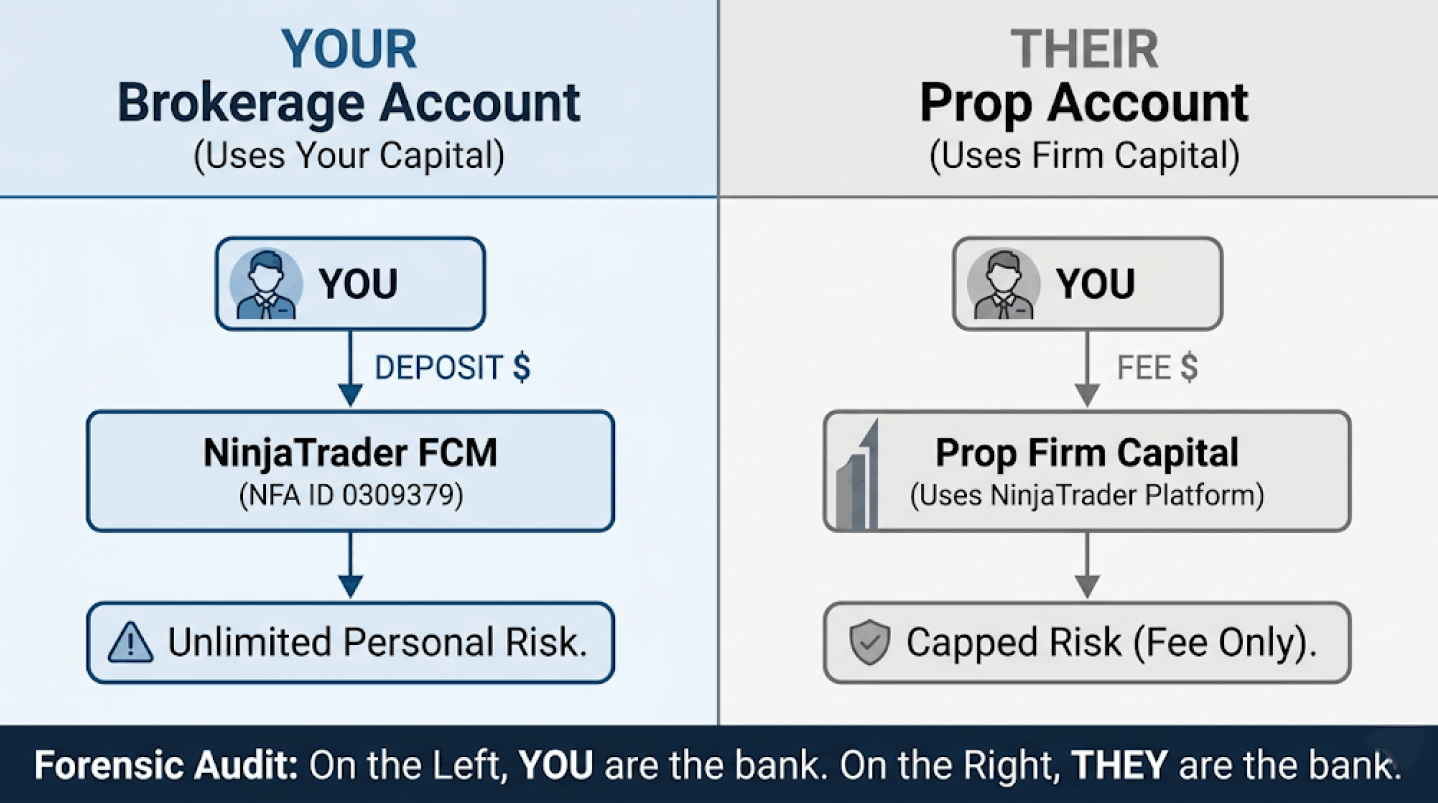
NinjaTrader Brokerage vs. a Futures Prop Firm
| Feature | NinjaTrader brokerage account | Futures prop firm account |
| Primary role | Brokerage and trading platform | Evaluation and account-program provider |
| Entity Offering Trading Capital | Trader’s personal capital | Firm-defined funded or simulated-funded model |
| How access is obtained | You open and fund a brokerage account | You enroll in an evaluation and satisfy the firm’s requirements |
| Profit treatment | You retain account gains after applicable costs | Payouts and profit splits follow the firm’s terms |
| Personal financial exposure | Trading losses and costs affect your deposited funds | Costs may include evaluation, subscription, reset, activation, or related fees |
| Main risk requirements | Brokerage margin and liquidation requirements | Drawdown, daily loss, consistency, and contract rules |
| Trading software | NinjaTrader or another brokerage-supported interface | NinjaTrader or another platform supported by the firm |
| Who establishes the rules | The broker, exchanges, and applicable regulators | The prop firm |
| Overnight trading | Subject to brokerage margin requirements | Depends on the firm and selected account type |
NinjaTrader maintains direct technical partnerships with several prop firms, meaning a trader who passes an evaluation at firms like Apex Trader Funding may find themselves executing trades inside the NinjaTrader interface without having purchased a NinjaTrader account separately. In this arrangement, the prop firm provides the capital and the rules while NinjaTrader provides the execution environment. This is the most common way a beginner will encounter NinjaTrader in the prop trading space, as the platform inside a funded account, not as the firm providing that account.
Note on Platform Access: Some prop firms include access to NinjaTrader and the required platform entitlements while an evaluation or funded account remains active. For a personal NinjaTrader Brokerage account, traders can use the Free plan or select the Monthly or Lifetime plan for different commission rates and platform benefits. Current NinjaTrader versions generally use account-based entitlements rather than traditional license keys.
How Technology and Risk Rules Help Traders Grow
1. Professional Tools for Everyday Traders
The partnership between NinjaTrader and funding programs gives everyday traders access to professional trading technology. NinjaTrader’s advanced software works with fast connections such as Rithmic (a third-party futures market-data and order-routing connection) and Tradovate to support smooth order execution. Rithmic accounts typically use a username, password, and designated server for NinjaTrader Desktop, while Tradovate credentials (the login details used to access a Tradovate trading account) may support compatible desktop, web, or mobile platforms depending on the prop firm and account type.
2. Understanding Margin: Safety Rails for the Market
In futures trading, “margin” isn’t a penalty. Major exchanges, like the CME Group, set these margin rules to protect the entire financial system. These requirements help ensure that market participants can meet their financial obligations and reduce counterparty and broader systemic risk. Understanding how margin works can help traders account for market volatility and manage their trading capital responsibly.
3. Turning Rules Into Good Habits
Risk parameters, such as daily loss limits and trailing drawdowns, act as automated risk-management tools modeled on professional trading standards. Brokerage accounts generally depend on trader-managed controls and margin buffers, while prop firm accounts apply predefined limits that automatically adjust account access when reached. Consistently planning trades around these boundaries turns account rules into practical habits that support disciplined risk management and long-term account stability.
Final Thoughts
NinjaTrader is a trading platform and regulated brokerage. Before allocating capital, consider setting clear risk limits based on your account size, experience, and tolerance for loss. For example, some traders may choose to limit their position size to one contract per $25,000 in account equity as a conservative personal guideline. Always confirm the overnight margin requirement for every instrument you intend to hold, and don’t mistake intraday margin as the limit of your safe risk.
Running NinjaTrader with personal capital requires you to meet margin requirements for each contract. Prop firms like Apex Trader Funding offer account structures where traders operate under predefined risk parameters using the firm’s capital rather than their own.
Disclaimer: Futures trading involves substantial risk and may not be suitable for every trader. Leverage can increase losses, and trading conditions may change. Review the applicable terms and consider your financial circumstances before trading.