Executive Summary: Prop firm scaling can increase a trader’s account size or contract allowance based on different program rules. Some firms use milestones such as profit, consistency, or payout requirements, while others use dynamic contract ladders tied to balance or equity thresholds. Traders should understand the specific scaling model and adjust risk gradually as trading capacity increases.
Introduction
Proprietary trading firms provide traders with an evaluation designed to assess whether they can adhere to specific performance and account-management rules. During the evaluation, you trade under conditions such as a profit target, a drawdown limit, a minimum trading period, or a consistency requirement.
Successfully completing the evaluation can qualify you for a funded account. Depending on the firm’s model, this may be a simulated account through which eligible traders receive performance-based payouts. You remain responsible for following the program’s rules while producing consistent results.
A funded account does not always remain at its original size. Some prop firms use scaling to gradually increase the capital allocated to traders who have demonstrated consistent performance and responsible account management.
What Is Scaling in a Prop Firm and How Does It Work?
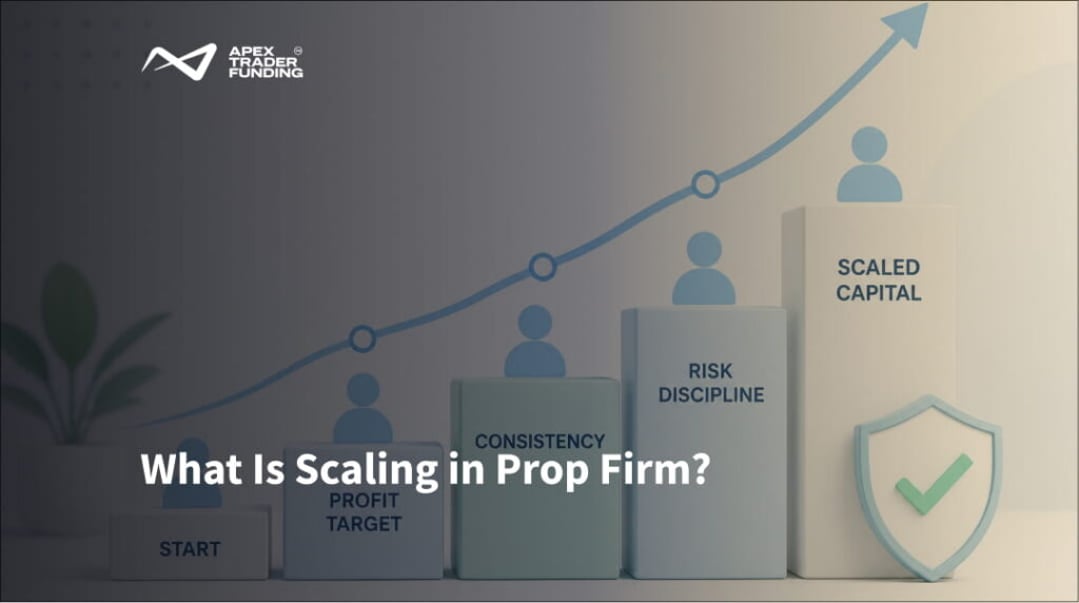
Prop firm scaling expands a trader’s available trading capacity after specified performance or account-value requirements are met. Depending on the program, scaling may increase the account’s capital allocation through progressive tiers or adjust the maximum number of futures contracts permitted under a dynamic contract ladder.
1. Capital-Allocation Scaling
Capital-allocation scaling is a performance-based process through which a firm increases the size of an eligible trader’s funded account. Instead of completing another evaluation for a larger account, the trader progresses through predefined capital tiers.
For example, a scaling plan might increase a $100,000 account by 25% after the applicable requirements are met:
| Scaling detail | Illustrative example |
| Starting account size | $100,000 |
| Cumulative profit requirement | 10% |
| Review period | Four months |
| Capital increase | 25% |
| New account size | $125,000 |
A firm may offer several progressive tiers like:
$100,000 → $125,000 → $156,250
The account is generally reviewed after the trader reaches a performance milestone or completes a defined period. Requirements may include:
Consistency ratio = (Highest single-day profit ÷ Total cumulative profit) × 100
If a trader earned $8,000 in cumulative profit and $5,000 came from one day, the consistency ratio would be:
($5,000 ÷ $8,000) × 100 = 62.5%
That result would exceed a Consistency Ratio Cap of either 40% or 50%. The account may need to produce additional qualifying profit before satisfying the consistency condition. The account must also remain compliant with its daily loss and overall drawdown rules. A firm may check whether the balance and equity remain above the required levels and whether the account breached its Trailing Drawdown Stop during the scaling cycle.
2. Dynamic Contract Ladders
Dynamic contract ladders are common in futures prop trading. Under this model, the account’s stated balance does not increase. Instead, the firm expands the maximum number of contracts the trader may hold as the account reaches specified equity levels.
An illustrative ladder could work as follows:
| Current account equity | Maximum contracts |
| $50,000–$51,500 | 2 contracts |
| $51,501–$53,000 | 4 contracts |
| $53,001 or more | 6 contracts |
If the qualifying value rises from $51,200 to $51,600, the account moves into the next tier and its limit increases from two contracts to four. The timing of this adjustment depends on how the program measures account value. An equity-based ladder may update intraday as equity crosses the threshold. An End-of-Day ladder may use the End-of-Day (EOD) Balance to determine the contract limit for the next trading day.
The same trigger mechanics apply when the qualifying value decreases. Under an intraday equity-based ladder, a drop from $51,600 to $51,400 may immediately return the account to the two-contract tier. Under an end-of-day model, the lower limit may take effect after the session closes or at the beginning of the next trading day. The trader must then follow the lower limit, meaning an order for three or four contracts would exceed the permitted size.
Unlike capital-allocation scaling, a dynamic ladder may not require several profitable months or a minimum number of payouts. Eligibility generally depends on reaching the applicable balance or equity threshold, remaining within the drawdown limit, following the active contract allowance, and complying with the program’s other trading rules.
| Requirement | Capital-allocation scaling | Dynamic contract ladder scaling |
| Main qualifying measure | Cumulative performance and account history | Current qualifying balance or equity |
| Base allocation of funded account | Increases after approval | Usually remains unchanged |
| Trading capacity | Expands through a larger allocation | Expands through higher contract limits |
| Common requirements | Profit, time, payouts, consistency, balance or equity, and clean standing | Tier threshold, drawdown compliance, and active contract limits |
| Downward adjustment | Program-specific | Contract limit may decrease with account value based on equity-based or end-of-day ladder. |
What Changes When Your Trading Capacity Is Scaled?
Scaling changes the dollar value of risk, account thresholds, or permitted position size. Capital-allocation scaling affects account-based values, while dynamic contract ladders adjust the number of contracts available as the qualifying balance or equity moves between tiers.
With capital-allocation scaling, the same risk percentage represents a larger dollar amount. For example, risking 0.5% on a $100,000 allocation places $500 at risk, while 0.5% on a $125,000 allocation places $625 at risk. The new tier may also change the profit-target baseline, static or trailing drawdown threshold, payout conditions, profit split, and maximum position limit. These features may not increase proportionally with the allocation.
With a dynamic contract ladder, a higher contract allowance increases the dollar impact of each market movement. Larger positions can produce greater profits or losses, while a lower contract tier reduces both potential outcomes. The account’s stated starting balance remains unchanged.
Neither model requires an immediate increase in exposure. The same trade-selection, entry, and exit standards can continue under the new limits.
Simple Strategies to Manage Scaling Safely
Strategy 1: Keep Percentage Risk Consistent
Maintain the same risk percentage after the capital allocation increases. A fixed rate preserves the strategy’s established risk structure, keeps each trade’s exposure proportional to the account size, and prevents scaling from becoming an unintended increase in risk.
For example, if an allocation increases from $100,000 to $125,000, a 25% increase, planned risk could rise from $500 to $625 while remaining at 0.5% per trade. Although the dollar amount is higher, each trade still affects the same proportion of the account. A loss equals 0.5% of the allocation in either case, preventing the larger account from causing a disproportionate increase in exposure.
Expert Tip: Watch for scaling tilt, the tendency to increase position size too quickly after an account scales up. For example, a trader who used a 0.5% risk limit on a $100,000 account could maintain the same risk percentage on a $125,000 account rather than immediately doubling position size. Gradual adjustments can help keep risk consistent as trading capacity increases.
Strategy 2: Build a Buffer Before Using the Full New Capacity
Lot Size Scaling means increasing position size gradually as additional trading capacity becomes available. Although futures positions are measured in contracts rather than conventional lots, the term describes the same controlled adjustment of market exposure.
For a capital-allocation increase, a trader might use the following transition:
- Previous allocation: $80,000
- New allocation: $100,000
- Normal risk rate: 1%
- Temporary risk rate: 0.6%
- Full rate restored after establishing a predefined balance buffer
For a dynamic contract ladder, a trader moving from a two-contract limit to a four-contract limit could initially trade two E-mini contracts plus Micro contracts.
Because 1 E-mini contract generally equals 10 corresponding Micro E-mini contracts, such as MES or MNQ, adding 2–3 Micro contracts to an existing 2 E-mini position increases total exposure by approximately 10%–15%. This creates a smaller scaling step before moving to a larger contract size.
Strategy 3: Maintain Consistent, Repeatable Execution
Use comparable position sizes and follow the same entry and exit criteria throughout the scaling period. This helps prevent one unusually large trade or profitable day from having an excessive influence on overall performance.
To maintain consistency, monitor:
- Total qualifying profit
- The largest profitable day
- The share of total profit generated by that day
- Changes in position size and trade frequency
- The effect of payouts on qualifying profit
A steady trading approach can produce more evenly distributed profits across multiple sessions.
Strategy 4: Protect Drawdown and Contract-Tier Boundaries
Available risk should show how close the account is to its risk limit.
For capital-allocation scaling, the key boundary is the active drawdown threshold, for example:
- Current equity: $76,400
- Active drawdown threshold: $74,900
- Available drawdown room: $1,500
Although the account may have a much larger allocation, only $1,500 separates its current equity from the drawdown limit. Exposure should therefore be based on this remaining cushion and whether the threshold is static or trailing.
A static drawdown remains at a fixed level, while a trailing drawdown may move higher as the account reaches new highs. The exact calculation varies by program and may be based on unrealized equity, realized balance, or end-of-day values. When an account scales, traders should review how the drawdown threshold changes rather than assume that higher profits create a wider risk buffer.
For dynamic contract ladders, the key boundary is the minimum balance or equity required to maintain the current contract tier. For example, if four contracts require a minimum balance of $52,000, a trader could set an internal reduction point at $52,300. This provides a buffer before reaching the program’s official threshold and potentially moving to a lower contract tier.
Conclusion
Scaling should support a trader’s progress without changing the process that produced it. Whether capacity grows through a larger allocation or additional contracts, the value of a higher tier depends on using it with the same consistency and risk control.
Traders can compare whether capital-allocation scaling or a higher contract allowance better suits their approach. Those interested in testing a futures prop firm can review Apex Trader Funding, while distinguishing between its End-of-Day (EOD) threshold and Intraday trailing-drawdown account models. Apex offers scaling tiers based on account size, with transparent rules defining the requirements and limits for each tier.
Disclaimer: Prop firm scaling rules, contract limits, drawdown thresholds, and eligibility requirements vary by program and may change. Examples, figures, and estimates in this article are illustrative and may not reflect actual trading results or current program terms. Review the applicable rules before trading.