
Executive Summary: A funded trading account is a capital-allocation model where a proprietary trading firm (prop firm) provides market liquidity to independent traders. The trader operates within strict risk parameters, such as a 5% daily loss limit, and retains a 70% to 90% profit split, enabling participation in the markets without the financial commitment of self-funding.
What Is A Funded Trading Account?
A funded trading account is a trading account backed by a proprietary trading firm, often called a prop firm. Rather than requiring a large personal capital deposit, the firm allocates buying power to the trader, allowing them to participate in the markets through the firm’s capital base.
This model provides an alternative entry point for skilled traders to access professional-grade market liquidity without requiring large personal financial commitments. In exchange for providing capital and infrastructure, the firm receives a portion of the generated profits.
Funded trading programs are available across multiple asset classes, including forex, futures, stock indices, commodities, and, in some cases, cryptocurrencies.
Key Rules Every Trader Must Follow
Every funded account program operates within a defined set of risk management rules. These rules exist to protect both the trader and the firm’s capital. The most common rules include:
- Maximum Daily Loss Limit: This rule restricts how much capital can be lost during a single trading day. If losses reach the threshold—typically 4% to 5% of the account value—trading for that day ends automatically, and the account is flagged for review. This rule functions as a built-in stop-loss at the account level.
- Maximum Drawdown Limit: Drawdown rules define the maximum decline allowed in the account balance. Many firms set this limit between 8% and 10%, measured either from the starting balance or from the account’s highest achieved balance.
- Minimum Trading Day Requirement: Most evaluation programs require trading activity over multiple days, often between 4 and 10 trading days. This helps firms assess consistency rather than performance from a small number of trades.
- Position Holding Restrictions: Some firms do not allow positions to remain open over weekends because market gaps can create significant price movements when trading resumes.
- News Trading Restrictions: Firms frequently restrict order execution 2 to 5 minutes before and after high-impact macroeconomic data releases. Volatile events that trigger restricted periods include U.S. Bureau of Labor Statistics releases like Non-Farm Payrolls (NFP) and the Consumer Price Index (CPI), or Federal Open Market Committee (FOMC) interest rate announcements.
Before starting any evaluation or funded account program, it is important to review the firm’s rules, policies, and account requirements carefully. Understanding these guidelines can help traders avoid unnecessary rule violations and maintain account eligibility.
How Do Funded Trading Accounts Work: Step-by-Step Process
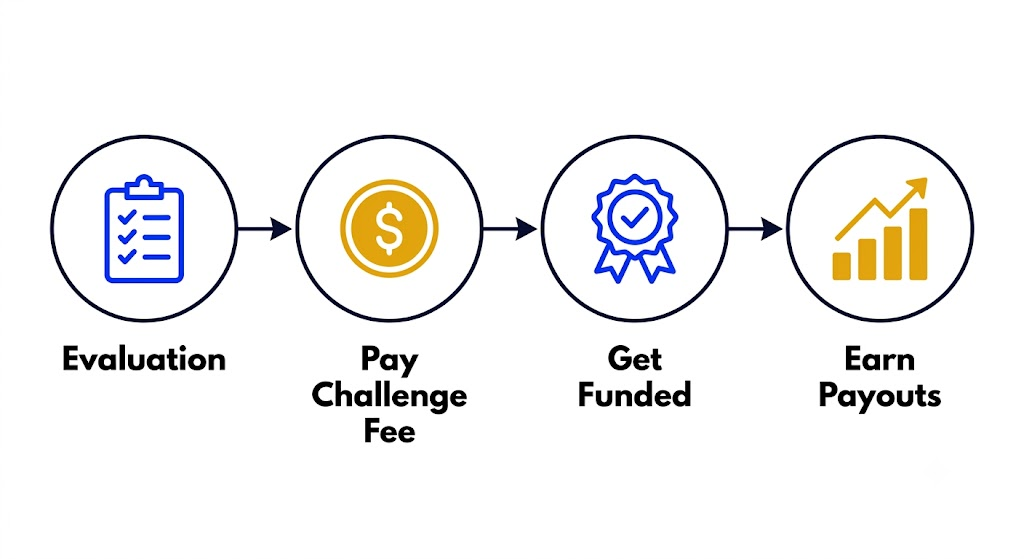
Step 1: The Evaluation or Challenge
Most prop firms require traders to pass a challenge before receiving a funded account. This is a simulated or live trading test where the trader must hit a profit target, usually between 8% and 10%, within a set number of trading days. At the same time, the trader must stay within a maximum daily loss limit and an overall drawdown limit.
For example, a firm may offer a 100,000 USD evaluation account. The trader must reach a 10% profit target, which is 10,000 USD, without losing more than 5% in a single day or 10% overall. If the trader achieves this without breaking any rules, they move forward.
Some firms offer a two-step evaluation, meaning the trader must pass two rounds before getting funded. Others offer instant funding with no evaluation but charge higher fees.
Step 2: Paying the Challenge Fee
To enter a challenge, traders typically pay a one-time fee. This fee varies based on account size. A 10,000 USD account challenge might cost around 100-250 USD. A 200,000 USD account challenge might cost 1,000 USD or more. Many firms refund the fee after the trader qualifies for payouts, although policies differ between providers.
This fee covers access to the evaluation program, trading platform infrastructure, market data, and account administration; it is a program access fee, not a capital deposit.
Step 3: Receive a Funded Account
After successfully completing the evaluation, the trader may receive a funded account. Depending on the firm’s model, this may involve access to real capital or a simulated account structure that pays real profits based on trading performance.
At this stage, the focus shifts from passing profit targets to maintaining consistent results while following the firm’s risk management rules. Traders are expected to continue respecting drawdown limits, position sizing requirements, and other account guidelines.
The primary utility of this model is providing capital allocation to skilled traders, allowing them to manage larger position sizes than their personal net worth would otherwise permit. This allows skilled traders to participate in larger market opportunities while operating within a structured risk framework.
Step 4: Earn Profit Splits and Request Payouts
Once a trader begins generating profits in the funded account, those profits are shared between the trader and the firm according to a predetermined profit split. Many funded account programs offer profit-sharing arrangements ranging from 70% to 90% for the trader, although payout structures vary across firms.
Most firms also establish minimum payout thresholds and payout schedules. Depending on the provider, traders may be able to request withdrawals weekly, biweekly, or monthly. Common payout methods include bank transfers, digital payment services, and cryptocurrency transfers.
Some firms also offer account scaling plans that reward long-term consistency. As traders demonstrate disciplined performance over multiple months, hitting profit targets while staying within drawdown limits, they may become eligible for larger account allocations and increased buying power. This means a trader who starts with a $50,000 account could progress to $100,000, $200,000, or beyond without contributing additional personal capital.
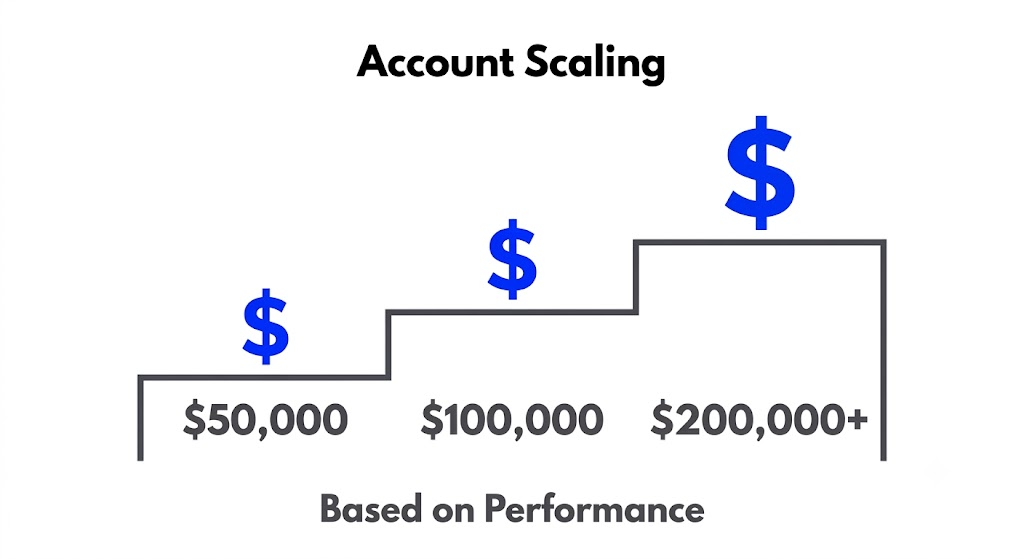
For skilled traders, scaling represents one of the prop model’s most significant advantages over retail trading: the ability to grow purchasing power in proportion to proven performance, not personal net worth.
What Type of Capital Do Funded Accounts Use?
One of the most frequently asked questions about funded trading accounts is how the capital structure works.
Funded account programs can operate in different ways depending on the proprietary trading firm’s business model. Some firms provide direct access to live market accounts. Others operate through performance-tracking environments that mirror real market prices; in both cases, qualifying traders receive real profit payouts based on their results.
Regardless of the structure, traders are evaluated on their ability to follow risk management rules, maintain consistency, and generate profitable results within the firm’s guidelines. When a trader qualifies for payouts, profits are paid according to the firm’s profit-sharing agreement.
Because funding models vary across the industry, traders should review a firm’s account structure, trading conditions, and payout policies before joining a program.
Who Can Apply for a Funded Trading Account?
Most funded trading programs are open to individuals who have a basic understanding of financial markets and trading principles. Unlike many traditional finance careers, funded trading typically does not require a university degree, professional certification, or prior industry experience. Traders must simply satisfy basic identity verification — a standard process requiring government-issued ID and proof of address, in line with Know Your Customer (KYC) and Anti-Money Laundering (AML) regulations, and meet minimum age restrictions (18+ years old).
Eligibility requirements vary by firm and location. Some providers may restrict participation in certain countries due to regulatory or compliance requirements.
Depending on the program, traders may have access to a variety of markets, including:
- Forex currency pairs
- Stock indices
- Futures contracts
- Commodities
- Precious metals
- Energy markets
Popular instruments often include the S&P 500, NASDAQ-100, gold, crude oil, and major currency pairs such as EUR/USD and GBP/USD.
Final Thoughts
Funded trading accounts allow traders to access larger amounts of capital while following structured risk management rules. Success depends on consistency, discipline, and the ability to manage risk effectively over time.
Firms such as Apex Trader Funding have helped expand access to funded futures trading through evaluation-based programs. Regardless of the firm chosen, understanding the rules and maintaining a disciplined approach are essential for long-term success.
Disclaimer: This article is for informational and educational purposes only and does not constitute financial, investment, or trading advice. Trading involves risk, and past performance does not guarantee future results.