Executive Summary: Funded trading is a performance-based arrangement where traders access firm capital by demonstrating consistent, rule-based performance through a structured evaluation. Success in these programs comes down to one thing: disciplined risk management — specifically, understanding and protecting your drawdown limit at every stage.
This guide breaks down exactly how funded trading works, what it genuinely costs, how to read the rules that matter most, and how experienced traders approach each phase systematically. Whether you’re evaluating your first program or refining an existing approach, the principles here apply directly to building a fundable edge.
What Is Funded Trading?
Modern prop firms present an opportunity to trade larger accounts with a relatively small upfront investment. For aspiring traders, this provides access to increased buying power along with a structured environment for skill development and market experience.
Over time, it becomes clear that funded trading is not only about account size, but also about demonstrating consistent performance, maintaining disciplined risk management, and following a structured trading process.
In this ecosystem, you aren’t initially a partner; you are an applicant. You pay an evaluation fee to prove you can hit a specific profit target without breaching a loss limit. If you succeed, you move into a funded phase where profits are shared according to the firm’s payout structure. The account size on your dashboard — whether that’s $50,000 or $150,000 — represents your total buying power in the market. But the number that actually governs your trading decisions is the drawdown limit (the maximum amount your account balance is allowed to fall from its starting point before the firm closes your account). That’s your real operating budget. Professional traders anchor every position size, every stop placement, and every session target to the drawdown figure, not the nominal balance.
The evaluation environment also gives you something valuable that live trading rarely offers early in a career: a consequence-free window to stress-test your strategy across different market conditions. Use it deliberately. Traders who treat the evaluation as pure data collection — logging every trade, reviewing every session — arrive at the funded phase with a clearer picture of their edge than those who simply try to hit the target as fast as possible.
How Does Funded Trading Work?
Funded trading is a contractual arrangement where a Proprietary Trading Firm provides a trader with access to a simulated or live account in exchange for a performance fee. The trader must meet specific profit targets (typically 8–10%) without exceeding drawdown limits (usually 4–6%). If successful, the trader receives a profit split, typically ranging from 80% to 95%.
The standard path in 2026 follows these four technical milestones:
- Selection: Choosing between a CME-regulated Futures firm or a Forex prop firm.
- Evaluation Phase: Proving Risk-Adjusted Returns over a set number of minimum trading days.
- Verification: Some firms use a secondary assessment phase designed to confirm consistency over a broader sample of trading activity before granting funded status.
- Onboarding: Signing the contractor agreement and paying the activation fee.
During the evaluation phase, you’re working within a simulated account environment, which serves an important purpose on both sides. For the trader, it removes real financial risk while building a verifiable performance track record. For the firm, it provides the consistent data needed to assess whether a strategy is genuinely repeatable before committing institutional capital to it.
Think of it as a structured audition: the firm needs to see your edge across a meaningful sample of trades and market conditions before moving you from a simulated environment to live execution. Once you demonstrate consistent, rule-compliant performance, the goal shifts; the firm’s interest is now directly aligned with yours. Scaling funded traders who perform is how legitimate prop firms build long-term value.
Once a trader demonstrates consistent, rule-compliant performance, they become eligible to participate in the firm’s funded program under the specific terms of that firm’s model.
How Do You Get a Funded Account?
To get a funded account, you must select a reputable program, pay an evaluation fee, and reach a specific profit target—usually 8% to 10%—without breaching strict daily or maximum drawdown limits. Once you pass this phase and complete a KYC identity check, the firm grants you access to capital.
Most firms require traders to agree to program terms and complete identity verification through KYC procedures before participating in funded-account programs. In 2026, most prop firms use a one-step or two-step evaluation designed to assess trading consistency and risk management. After meeting the required objectives and completing verification, traders typically progress from a Challenge account to a Funded or Pro account, where they become eligible to earn payouts based on their performance.
What is the Cost of Funded Trading?
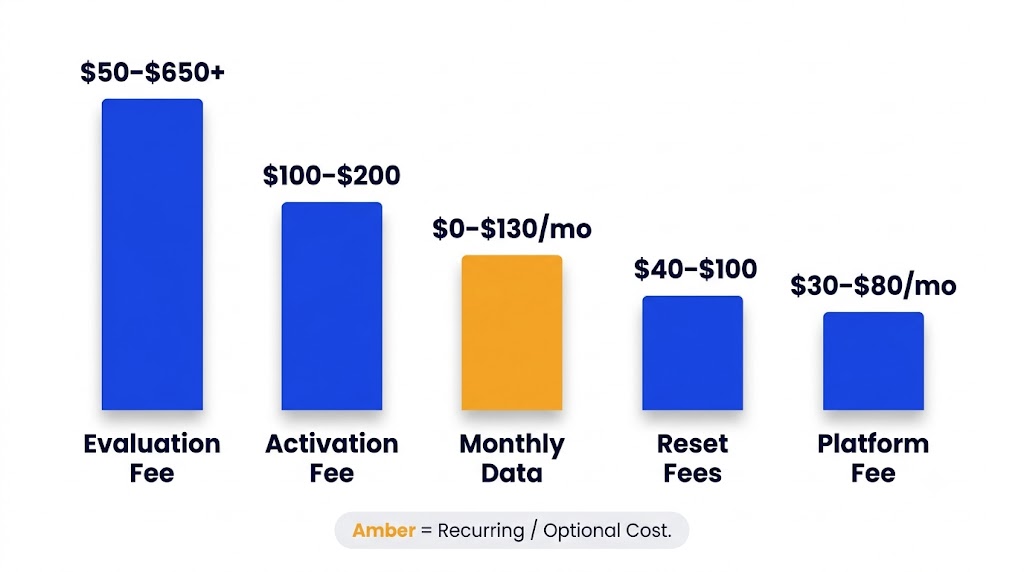
The cost of funded trading includes the initial evaluation fee ($50–$650), mandatory CME Level 2 Data subscriptions ($12–$130/mo), and one-time activation fees. Additionally, traders must factor in the “Opportunity Cost” of evaluation time and potential “Reset Fees,” which range from $40 to $100 per attempt.
The advertised fee is often only part of the total cost. When evaluating a new funding opportunity, it’s important to consider the additional expenses and requirements that many traders overlook:
| Cost Type | Estimated Price (2026) | Operational Note |
| Evaluation Fee | $50 – $650+ | One-time fee based on nominal Account Size. |
| Activation Fee | $100 – $200 | Most firms require a post-pass onboarding fee. |
| Monthly Data | $0 – $130/mo | Essential for Futures (CME – the Chicago Mercantile Exchange); often free for Forex. |
| Reset Fees | $40 – $100 | The cost to try again if you breach a rule. |
| Platform Fee | $30 – $80/mo | For pro tools like Sierra Chart or QuantTower. |
How to think about evaluation fees as a business investment
The most productive mental model for evaluation fees is to treat them as a business licensing cost — comparable to the cost of a professional certification or the monthly overhead of any performance-based career. A $500 evaluation fee for access to a $100,000 funded account represents a 200:1 leverage ratio on your initial capital outlay if you pass. Few professional trading opportunities provide access to that level of buying power with such a limited upfront financial commitment.
This framing also changes how you approach the preparation phase. A professional preparing for a licensing exam doesn’t sit the exam repeatedly, hoping to get lucky on a good day — they prepare systematically until they’re confident their skill level clears the bar consistently. The same logic applies here: the evaluation fee is best spent once, on a well-prepared attempt, rather than repeatedly on rushed restarts.
Once you understand the full cost structure, the next question every prospective funded trader should ask is: how do you assess whether a specific program is built on a credible, transparent operational foundation?
Is Funded Trading Legit and Worth the Effort?
Funded trading is legitimate, and for traders who approach it with preparation and discipline, it offers one of the most efficient structures in modern markets for accessing significant capital with a defined, limited upfront cost. Like any professional performance environment, the quality of your experience depends heavily on which program you choose and how seriously you treat the preparation phase.
The most important factor in evaluating any funded trading program is understanding where your trades actually execute. This single question separates the most credible programs from the ones that require closer scrutiny.
Futures-based programs that operate through the CME (Chicago Mercantile Exchange) sit at the top of the legitimacy spectrum. Every trade clears through a centralized, regulated exchange governed by CFTC and NFA oversight. The pricing data you see is identical to what institutional traders see; there is no firm-side pricing, no internal matching, and no ambiguity about execution quality. For traders who want the cleanest, most professionally structured environment, CME-regulated futures programs are the benchmark.
Forex and CFD-based programs vary more widely in their execution models. CFD is a type of financial instrument common in Forex prop trading, where you speculate on price movement without owning the underlying asset. CFDs are offered through brokers who set their own prices rather than through a central exchange — execution standards vary significantly between providers.
Some route orders directly to external liquidity providers; others use internal execution models — sometimes called B-Book models — where trades are matched within the platform rather than on an external exchange. Neither model is automatically disqualifying, but the execution structure should be clearly disclosed in the firm’s documentation. Reputable programs are transparent about this. If a firm cannot clearly explain how your trades execute and where the pricing originates, that is a meaningful prompt to ask directly before committing evaluation fees.
On the question of whether it is worth the effort, the structure itself is genuinely compelling for disciplined traders. You are paying a fixed, defined evaluation fee for the opportunity to control a substantially larger pool of capital. If the evaluation does not go as planned, your maximum loss is that fee — there are no margin calls, no account deficits, and no ongoing liability. If you pass and perform consistently, the profit split structure means your earnings scale directly with your trading quality.
The honest answer to “is it worth it?” is: it depends entirely on your preparation level. Traders who arrive at an evaluation with a documented strategy, consistent risk habits, and a clear understanding of the program’s specific drawdown rules have a structurally different experience than those who approach it speculatively. The program itself does not determine the outcome — the quality of your preparation does. That distinction is what makes funded trading a legitimate professional tool.
Comparison: Forex vs. Futures Funded Trading (2026)
| Feature | Forex / CFD Prop Firms | Futures Prop Firms (CME) |
| Market Structure | Decentralized: Prices vary slightly between different brokers/liquidity providers. | Centralized: All traders see the same price and volume from a single exchange (e.g., CME). |
| Regulation | Low/Varies: Many operate offshore; often unregulated or “lightly” regulated. | High: Governed by CFTC/NFA rules; trades are cleared through official exchanges. |
| Data Costs | Usually Free: Most firms provide “demo” data for free within the platform. | Paid Subscription: Requires a monthly fee for Level 1 or Level 2 exchange data ($12–$130). |
| Pricing Model | Spread-Based: You pay the difference between the Buy and Sell price (plus small commissions). | Commission-Based: Spreads are paper-thin, but you pay a fixed fee per “round-turn” contract. |
| Trading Hours | 24/5: Open Sunday evening to Friday evening without breaks. | 23/5: Includes a daily 1-hour settlement break where trading is halted. |
| Asset Variety | High: Includes Currencies, Gold, Oil, Crypto, and sometimes Individual Stocks. | Focused: Limited to exchange-traded contracts (Indices, Metals, Energy, Ags, and FX Futures). |
| Account Fees | One-Time: Usually a single fee for the evaluation (often refundable upon passing). | Subscription: Often monthly fees until you pass, plus one-time “Activation Fees.” |
Legitimacy Update (2026):
Organizations such as the Financial Conduct Authority and CME Group regularly emphasize the importance of risk management and transparency in leveraged trading. For traders evaluating a prop firm, clear account rules, risk controls, and payout policies are often key indicators of a well-structured program.
When evaluating any funded trading program, focus on factors that directly affect your experience as a trader:
- Transparent rules and drawdown policies
- Clearly defined payout procedures
- Reliable trading platforms and market data
- Responsive customer support
- A track record of consistent trader payouts
Programs that clearly communicate how their rules work and how traders progress through each phase are generally easier to evaluate and compare.
How Do Profit Splits and Potential Work?
Profit potential is significant, with standard splits typically allowing traders to keep 80% to 90% of their gains. However, you must often maintain a “safety buffer” in the account before withdrawing. This ensures the firm’s capital remains protected while you scale your earnings toward professional-level payouts.
Most firms also structure payouts with a minimum earnings threshold — typically requiring the account to reach a balance that covers the drawdown limit before the first withdrawal is processed. For example, if my drawdown limit is $3,000, the firm may require me to earn $5,000 before I can request a payout, ensuring the account has demonstrated genuine, sustained growth before funds are distributed. Once that threshold is reached, the payout process is straightforward: request, verify, receive.
Which Platforms and Tools are Required?
The industry standard for funded trading requires high-performance platforms like Tradovate or NinjaTrader for Futures, and MetaTrader 5 or cTrader for Forex. These are supported by professional charting tools like TradingView for analysis and risk-management software to automate loss limits and prevent emotional “revenge trading” errors.
Many traders rely on a combination of charting, execution, and risk-management tools. Platforms such as TradingView are commonly used for market analysis, while execution platforms like Tradovate or Rithmic handle trade placement and order management. Some traders also use risk-control software that can automatically restrict trading after a predefined loss limit is reached, helping enforce disciplined risk management and reduce emotional decision-making.
The Compliance Checklist
Before placing a trade, it is important to review the key rules and risk parameters for your account. In many funded programs, a single rule violation can result in account failure regardless of whether the trade itself is profitable.
- [ ] Check the High-Impact News Calendar: Ensure no high-impact economic events (often marked in red on economic calendars and called Red Folder events) (CPI, FOMC, NFP) occur within 2 minutes of your trade. Professional prop firms often restrict trading around major news events because they can create sharp volatility and unpredictable market conditions. Trading outside these periods helps ensure more stable liquidity and price action.
- [ ] Verify “Flat” Status for Market Close: Ensure all positions and pending limit orders are cancelled 5–10 minutes before the daily settlement break (usually 5:00 PM EST for Futures).
- [ ] Calculate the Slippage Buffer: On high-volatility days, avoid placing your stop loss right at the maximum daily loss limit. Leave additional room for slippage and sudden market volatility.
- [ ] Confirm Data Feed Integrity: Check that your Rithmic or CQG credentials haven’t timed out. A “frozen” chart is the fastest way to hit a trailing drawdown (a drawdown limit that moves upward as your balance grows, so your floor rises with your profits) by accident.
- [ ] Monitor the Consistency Metric: Ensure your current daily profit doesn’t exceed 30–40% of your total account gain to stay compliant with your program’s consistency requirements — most firms require performance to be distributed across multiple trading days to qualify for a payout.
The Technical Margin of Error: Execution vs. Reality
Even a strong trading strategy can be affected by technical issues such as connection problems, platform delays, or execution errors. Before trading live capital, it is important to ensure your trading setup, software, and internet connection are reliable enough to support consistent execution in fast-moving markets.
- The 200ms Latency Trap: Before trading live capital, it is worth checking the connection speed to the firm’s data servers, such as those used for CME futures or major forex trading hubs. Higher latency can create delays between the price displayed on screen and the price at which an order is executed. During periods of elevated market volatility, these delays may increase slippage, resulting in trade entries or exits occurring at different prices than expected.
- Server-Side OCO (One Cancels the Other): This is the single most important safety setting in your platform. Ensure your software supports Server-Side OCO orders. This means that once you place a trade with a Take Profit and a Stop Loss, those orders are held on the firm’s exchange server, not your local computer.
- The Risk: If your home internet cuts out or your laptop freezes while using “Local” orders, your Stop Loss effectively disappears.
- The Solution: With Server-Side OCO, the firm’s server will close your trade even if your house loses power.
What is the “Effective Risk Capital”?
Effective Risk Capital is your true trading balance, defined by the maximum permitted drawdown rather than the nominal account size. In a $100,000 account with a $5,000 drawdown, your actual capital is only $5,000. Your leverage and position sizing must be calculated based on this smaller, “at-risk” figure.
To understand how these programs work, ignore the large account balance. What really matters is this simple formula:
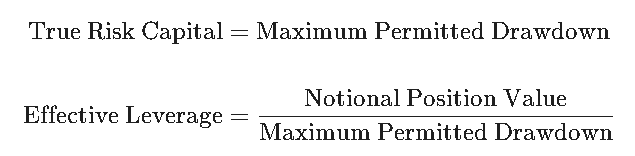
In simpler terms: Your “leverage” or power to move big positions is based entirely on the money you are allowed to lose, not the $100,000 balance you see on the dashboard.
Experienced funded traders consistently identify the same pattern in failed accounts — including their own. The problem is rarely a flawed strategy. It is not adjusting their behavior as the account grows. When your balance rises on a trailing drawdown program, your liquidation floor rises with it — but it never comes back down. The room between your current balance and that floor stays roughly the same in dollar terms, but traders who respond to a growing balance by sizing up or pushing daily targets are effectively reducing their actual margin for error at the worst possible time.
The adjustment is simple but counterintuitive: treat a growing account as a reason to protect what you have built, not a signal to press harder. Keep position sizing anchored to the original drawdown limit, not the current balance.
Managing your drawdown correctly protects your account from market risk. The next discipline — news window compliance — protects it from contractual risk, and it is the one most traders don’t think about until it costs them.
News Window Rules: What Every Trader Needs To Know Before Their First Session
One of the most consistently overlooked preparation steps among new funded traders is understanding how news window restrictions work — and building a session routine that accounts for them automatically. Most firms prohibit opening or closing trades within a 2-to-5-minute window surrounding “High Impact” economic releases (e.g., Non-Farm Payrolls or FOMC Interest Rate decisions).
The risk isn’t only the market moving against you — it’s an unintentional contract violation. Even a profitable trade executed during a restricted news window falls outside the program’s compliance terms, because the firm cannot reliably hedge positions taken during those periods. Understanding exactly when those windows apply, and building a pre-session routine that accounts for them, is one of the most straightforward ways to protect a funded account.
Here’s how that plays out in practice: it’s Friday at 8:29 AM EST. You identify a clean setup on the S&P 500 and enter long with 5 contracts. At 8:30, the Non-Farm Payroll report drops. The market spikes in your direction, and you close at 8:31 for a $4,000 gain.
That entry fell within the restricted window your contract specifies around high-impact releases. Because the firm cannot reliably hedge positions taken during these windows, trades executed during them fall outside the program’s compliance terms — regardless of outcome. The gain would not be counted, and repeated violations typically result in account termination.
This isn’t a punitive rule; it reflects the operational constraints of how firms manage risk around volatility events. The practical solution is straightforward: set a calendar alert for every high-impact release and treat the 10 minutes around it as a no-trade window. You protect your account and still have full access to the post-news trend once the window clears.
Types of Drawdown Structures
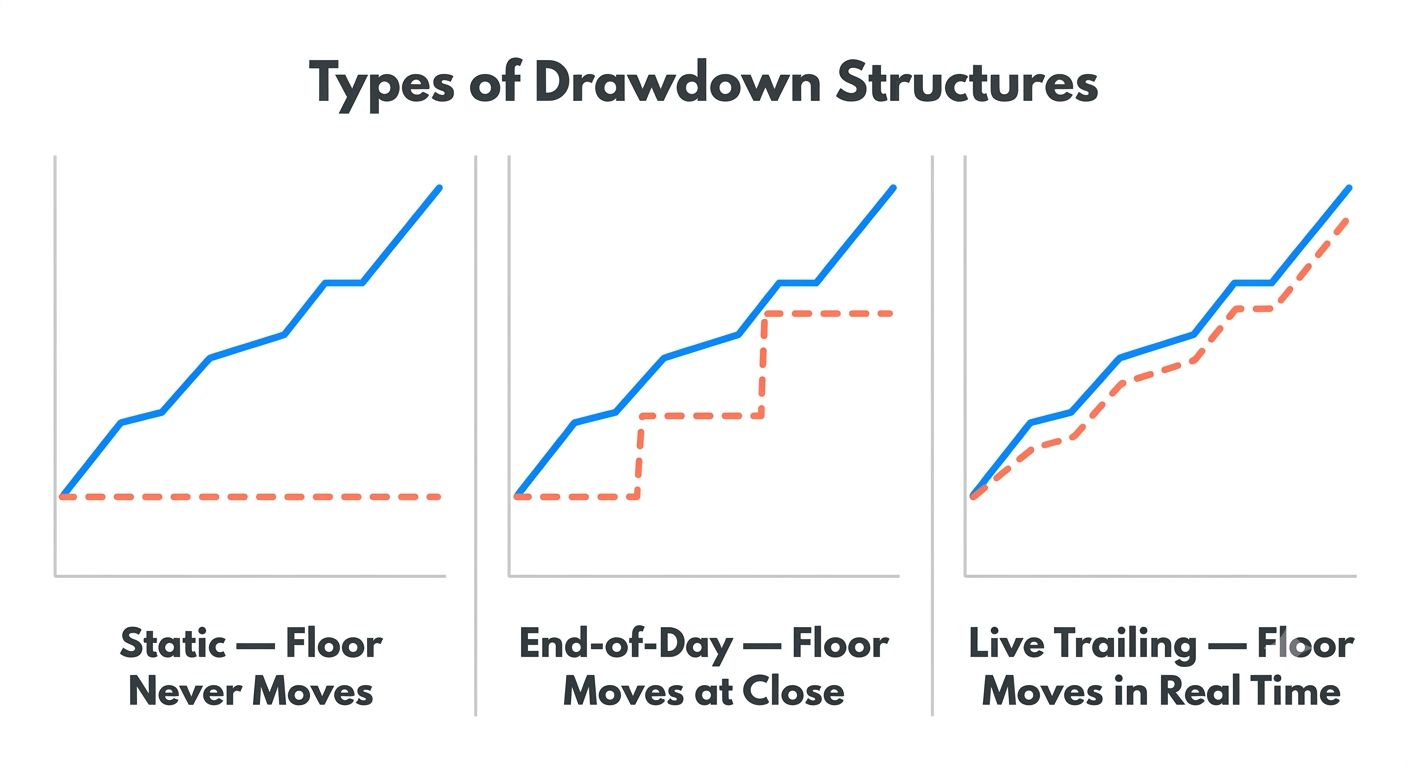
How aggressively that floor moves depends entirely on which drawdown structure your program uses — and understanding the difference between the three main types is one of the most important decisions you will make before your first evaluation.
- Static Drawdown (The Most Lenient): This is a fixed line in the sand. If you have a $100,000 account with a $5,000 static drawdown, your account fails only if your balance hits $95,000. It never moves, regardless of how much profit you make.
- End-of-Day (EOD) Drawdown: This “trails” your profit, but only calculates at the close of the trading day. If you start at $100,000 and end the day at $102,000, your new liquidation point moves up by $2,000. It gives you “breathing room” during the intraday swings.
- Live Trailing Drawdown (The Most Difficult): This moves upward in real-time as your open trades go into profit. If you are up $2,000 mid-trade, your drawdown floor moves up $2,000 instantly. If the market then retraces and you close the trade at breakeven, you have actually lost $2,000 of your “risk room.”
What Funded Traders Who Succeed Do Differently
Funded traders who build consistent careers — across multiple programs and payouts — share a recognizable set of habits that have nothing to do with finding a perfect strategy. They size positions as a fixed percentage of the drawdown limit, not the nominal balance. They keep a trade journal that records not just entry and exit but the reasoning behind each decision, which lets them audit patterns across weeks rather than single sessions. They define their maximum acceptable loss per day before the session opens and use platform rules or risk management software to enforce it automatically, removing the emotional decision in the moment. And they approach the evaluation phase as a performance sample — not a target to hit as quickly as possible — which produces more consistent results and a cleaner track record when the firm reviews their history.
These aren’t advanced techniques. They’re professional habits that any trader can build before their first evaluation begins.
Expert Insight:
A trader may treat funded account fees as a limited-risk entry cost for a major opportunity. For example, if a trader pays $500 for a $5,000 drawdown account, the maximum initial loss is $500. A disciplined trader should avoid using the “Reset” button more than once a month. The safety buffer serves as a professional cushion, keeping the account in a healthy position while the trader builds a track record. It also means the first payout reflects sustained performance rather than a single strong trading run.
A “Withdrawal First” strategy can be useful: traders may consider taking their first payout once they reach the safety buffer, often around 5% above the drawdown level, and moving those funds to a personal account.
- Most firms also apply Consistency Rules, which are payout conditions designed to help verify that performance comes from a trading strategy rather than a single lucky trade. Typically, no single trading day can account for more than 30%–50% of total profits when a trader requests a withdrawal. If one day accounts for too much of the overall gains, the firm may require additional trading days before approving the payout.
The August 2025 Yen Unwind
During the August 2025 USD/JPY volatility event, the Japanese yen experienced sharp price swings that created elevated volatility across global markets. Such events can lead to wider spreads, faster price movements, and increased execution differences between expected and actual trade prices. For many traders, it highlighted the importance of understanding how drawdown rules and risk limits behave during periods of extreme market activity.
The August 2025 USD/JPY volatility event was a significant stress test for the funded trading industry — and its lessons remain directly relevant to program selection and account management today.
This is why drawdown structure selection — not just strategy quality — is a meaningful part of program evaluation. Understanding how your drawdown behaves during extreme volatility before you’re in it is part of professional preparation.
Is This Program Right For You Right Now?
Funded trading programs reward preparation. Before committing to evaluation fees, it’s worth an honest assessment against these four criteria:
- Do you have a defined strategy with at least 30 documented trades showing positive expectancy? If not, the evaluation is premature — use a practice account to build that sample first.
- Can you consistently respect a daily loss limit without exceptions? This is the single most important operational skill for a funded career. If you’ve overridden your stop loss even once in the past month, that’s the habit to address before an evaluation.
- Do you understand the specific drawdown structure of the program you’re considering — static, end-of-day, or live trailing — and have you sized your approach to fit that structure specifically?
- Have you reviewed the full contract terms, including news restrictions, consistency rules, and minimum trading day requirements? These details determine your payout eligibility and are worth knowing before your first trade, not after.
If you can answer yes to all four, you’re approaching the evaluation the way funded traders approach it — as a structured performance demonstration, not a speculative attempt.
Summary
Funded trading rewards the same qualities that define any professional performance career: preparation, consistency, and disciplined risk management. The programs themselves are tools — the outcome depends almost entirely on how deliberately you use them. You now understand how the cost structure works, how to evaluate a program’s legitimacy, how drawdown rules actually behave, and what separates traders who build lasting funded careers from those who restart evaluations repeatedly. That knowledge is the edge most applicants don’t arrive with. Use it before your first evaluation begins — not after.
Ready to apply what you’ve learned? Explore the official Apex Trader Funding site to choose account options like the 25K WealthCharts EOD Trail or 50K Tradovate Intraday Trail and choose the account structure that fits your trading style and preparation level.
Disclaimer: Trading futures and other leveraged financial instruments involves substantial risk of loss and is not appropriate for all investors. Past performance during an evaluation period is not indicative of future results in live trading conditions. Always review the full terms and conditions of any funded trading program before committing capital.
FAQs:
How do funded traders make money?
Funded traders make money by generating profits in a prop firm account while following the firm’s risk and drawdown rules. They typically receive a percentage of the profits, often between 80% and 95%, while the firm provides the trading capital. For example, if a trader earns $10,000 in eligible profits with a 90% profit split, they would receive $9,000 as a payout.
What happens if I fail a funded account?
Failing a funded account usually results in the account being closed for violating a firm’s risk or drawdown rules. Once the account is terminated, access to the firm’s capital and payouts ends. Most prop firms require traders to purchase a new evaluation or pay a reset fee before attempting to qualify again.
How much money can I lose on a funded account?
In most funded trading programs, your maximum loss is limited to the evaluation fee, subscription costs, and any platform fees you paid. If you breach the firm’s drawdown limit, the account is typically closed automatically. Unlike personal trading accounts, funded accounts generally do not expose traders to additional margin calls or losses beyond the amount they invested in the program.
Can I withdraw money from a funded account?
Yes. Most funded trading firms allow withdrawals once you meet their payout requirements. These typically include reaching a minimum profit threshold, satisfying trading-day requirements, and remaining within the firm’s risk limits. Payouts are usually based on a profit split, often ranging from 80% to 100% of eligible profits. This means traders can withdraw a portion of their gains while the firm retains the agreed share.