Executive Summary: A prop firm challenge is a structured evaluation designed to assess a trader’s ability to achieve an approximately 6% profit target while operating within defined parameters. Passing a prop firm evaluation is really about staying consistent and sticking to the rules around risk. It’s less about rushing to hit the target and more about showing steady, disciplined trading over time. Traders who approach the evaluation with a structured process tend to find it more manageable.
What Is a Prop Firm Challenge?
A prop firm challenge is a structured evaluation designed to assess a trader’s ability to generate consistent results while following predefined risk parameters. Depending on the provider, evaluations may follow a one-step or multi-phase format, with profit objectives commonly being 6% and drawdown limits typically set between 2% and 4%.
Traders who complete an evaluation may gain access to a funded account with a profit-sharing arrangement. Modern prop firms allow traders to retain the full approved payout, subject to minimum and maximum withdrawal amounts that vary by account size.
When evaluating a challenge, it is helpful to consider the relationship between the profit target and the available drawdown. This Target-to-Drawdown Ratio provides insight into how aggressively or conservatively a trader may need to approach the evaluation.
For example, a challenge requiring a 6% profit target with a 4% drawdown limit places a greater emphasis on disciplined risk management, position sizing, and consistency. Understanding this balance allows traders to select an evaluation model that aligns with their trading style and long-term objectives.
Here’s how to calculate the Target-to-Drawdown Ratio:
The Formula:
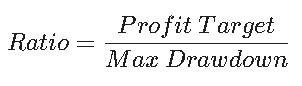
This ratio provides a practical measure of the challenge’s risk and reward structure. For example, a challenge requiring a 6% profit target with a 4% maximum drawdown has a Target-to-Drawdown Ratio of 1.5:1. The higher the ratio, the more important consistent execution, disciplined position sizing, and effective risk management become throughout the evaluation period.
Core Elements of a Modern Prop Firm Challenge
Before exploring specific strategies, it is helpful to understand the core evaluation parameters that shape modern prop firm challenges.
| Phase | Action | Goal |
| Preparation | Calculate risk based on the maximum drawdown rather than the headline account size. | Distribute the risk budget across multiple trades to limit the effect of any single outcome. |
| Execution | Use micro-lots or micro-contracts where available. | Enable scaling and reduce volatility impact. |
| Management | Position exposure must be considered to be reduced as the account progresses toward the profit target. | Protect account progress. |
| Compliance | Review exposure before major news events and market closures. | Reduce exposure to unexpected execution risk. |
How to Pass a Prop Firm Challenge: Step-by-Step Framework
To pass a prop firm challenge, traders should focus on aligning their strategy with the evaluation’s risk parameters and performance objectives. This typically involves using appropriately sized positions, taking advantage of micro contracts or smaller lot sizes where available, and establishing personal risk limits that remain comfortably within the firm’s maximum loss thresholds.
Successful evaluations are rarely the result of a few outsized trades. Instead, they are often achieved through consistent execution, disciplined risk management, and a repeatable trading process. By prioritizing account consistency over rapid profit accumulation, traders can create a more sustainable path toward reaching the evaluation target. The following framework outlines a practical step-by-step approach for navigating a modern prop firm challenge.
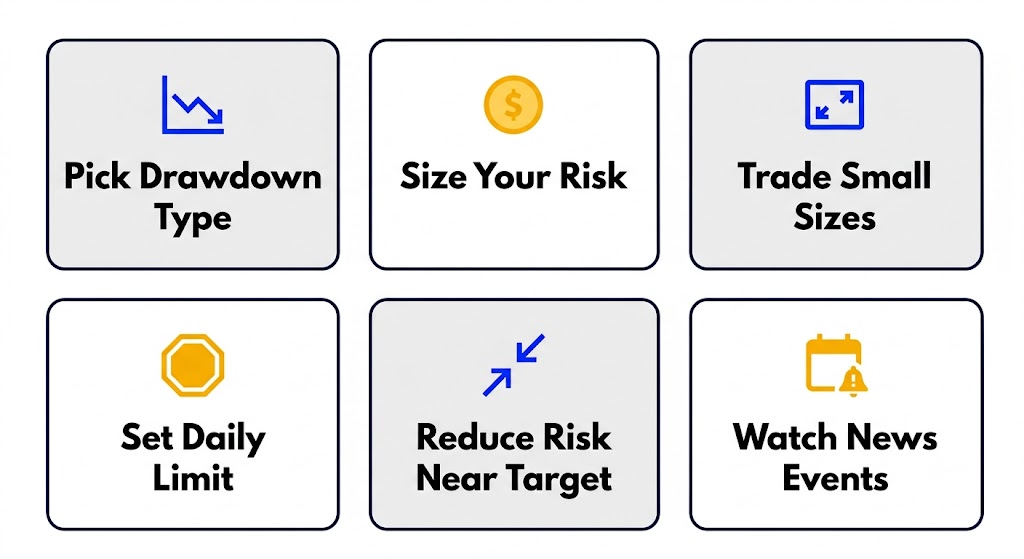
Step 1: Selecting the Drawdown Environment
In 2026, one of the most important factors in a prop firm challenge is the drawdown structure. Different models calculate risk limits differently, which can affect position sizing, trade management, and overall strategy execution.
- Trailing Drawdown (Intraday): The loss floor moves up as the account hits new highs — and unlike the account balance, it never moves back down. This means a strong early session raises the minimum balance a trader must stay above for the rest of the evaluation.
- EOD (End of Day) Drawdown: The loss limit is recalculated once per day, based on the closing account balance — meaning temporary dips during the session don’t immediately tighten the limit. Many traders prefer this structure because it gives more breathing room while a trade is still open.
Prop firms like Apex Trader Funding offer evaluation accounts for both Intraday and EOD trailing drawdown, giving traders access to both structures based on their preferred risk-management approach.
Step 2: Calibrate Risk to the Drawdown Limit
Before placing the first trade, it is important to focus on the maximum drawdown rather than the headline account balance. While a challenge may display a $100,000 account, the drawdown limit defines the amount of risk available throughout the evaluation and should serve as the foundation for position-sizing decisions.
Many traders choose to begin with smaller position sizes during the first few trading sessions while becoming familiar with the platform, evaluation rules, and account management requirements. This measured approach supports consistency and helps traders build confidence in the platform before scaling up.
Establishing a consistent unit of risk can help create a structured approach to position sizing throughout the evaluation. In today’s market environment, where volatility can fluctuate across asset classes and trading sessions, many traders rely on predefined risk limits to maintain consistency and avoid making emotional adjustments from trade to trade.
- A common starting point: Risk no more than 0.25% to 0.5% of the account’s stated value per trade.
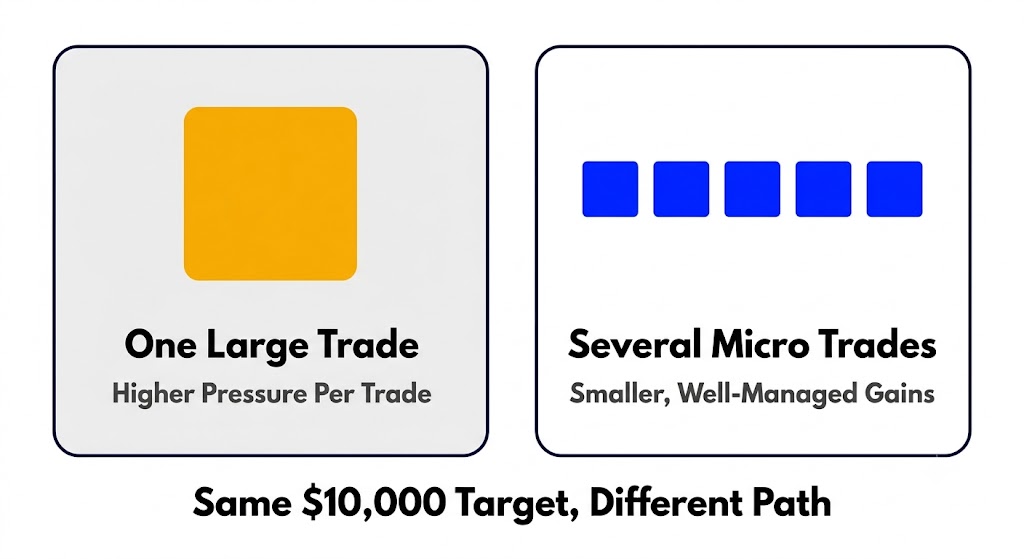
- Scenario: On a $100,000 account, that fixed risk amount, often called 1R, where R stands for the dollar value risked per trade, equals $250 when risking 0.25% per trade. At that level, a $10,000 profit target offers roughly 40 individual trade opportunities, giving traders a structured path to the goal rather than relying on a small number of large positions.
Step 3: Granular Position Sizing
Whether trading Forex or Futures, position sizing plays a significant role in maintaining consistency throughout an evaluation.
- The Execution: Utilize the smallest increments available, such as Micro lots in Forex (smaller trade sizes that allow more precise risk control) or Micro E-mini contracts in Futures.
- The Advantage: Smaller position sizes allow for greater flexibility when scaling into and out of trades. If the profit target is $10,000, there is no need to rely on a single high-risk trade to achieve that objective. Instead, the goal can be approached through a series of smaller, well-managed gains. This approach can reduce pressure on individual trades while supporting a more consistent account progression.
Step 4: Establish a Daily Risk Threshold
The Daily Loss Limit is the maximum permitted loss an account can incur during a single trading day. It is one of the most important risk parameters in a prop firm evaluation. For this reason, many traders establish personal daily loss thresholds that sit comfortably within the firm’s maximum limits. This creates an additional layer of risk management and helps maintain consistency throughout the challenge.
Many modern trading platforms allow traders to set a pre-configured daily loss ceiling — sometimes called a daily stop — so the account pauses automatically if the threshold is reached, removing the need to monitor it manually. Utilizing these tools can help traders adhere to predefined risk parameters and maintain a disciplined approach during periods of elevated market volatility.
Step 5: The Buffer Management Strategy
As a challenge account moves closer to its profit target, the relative importance of accumulated gains increases compared with the remaining objective.
- The Adjustment: Consider reducing risk per trade as account progress increases.
- The Logic: As account progress accumulates, preserving gains becomes increasingly important. Lower position risk can help support consistency while maintaining alignment with the firm’s evaluation requirements.
- Phase 2 Evaluations: For firms that use multi-stage assessments, maintaining the same risk-management framework across each phase can help create a more consistent trading process. While profit targets and rules may vary, disciplined execution remains important throughout the evaluation.
- Additional Consideration: Some prop firms offer one-step evaluation models, which can provide a more streamlined path to funding for traders who prefer a simplified assessment structure.
Step 6: Managing Event Volatility
Market liquidity can fluctuate during major economic events such as Federal Reserve interest rate decisions (announced by the Federal Open Market Committee, or FOMC) and European Central Bank (ECB) press conferences, which tend to bring short-term increases in market activity.
- The Step: Many traders choose to reduce exposure or close open positions ahead of high-impact economic releases.
- The Consideration: During major economic releases, prices can move quickly and fills may differ slightly from the expected price — this is called slippage, and it affects all market participants. Understanding how slippage affects trade execution can help traders manage risk more effectively during major news events.
How To Maintain Consistency After Funding?
Reaching a profit target and earning a funded account is an important milestone, but long-term success often depends on applying the same risk-management principles that supported progress during the evaluation. While account balances may increase, the underlying risk parameters and trading discipline required for consistent performance remain largely unchanged.
Many experienced traders continue to focus on position sizing, drawdown management, and process-driven execution after funding. Rather than increasing risk significantly, they prioritize consistency and sustainable account growth over time. This approach can help support a more stable payout trajectory while maintaining alignment with the firm’s risk framework.
Execution Consideration: Understanding your platform’s execution environment is part of professional preparation. Reputable firms publish their infrastructure and data-feed specifications; reviewing this before trading is a straightforward step that removes guesswork and builds confidence going in.
Final Thoughts
Passing a prop firm challenge in 2026 requires a disciplined approach to risk management, position sizing, and execution. By focusing on drawdown-aware risk allocation, utilizing micro contracts or smaller position sizes for greater flexibility, and managing exposure during high-impact market events, traders can build the consistency these evaluations are designed to reward.
Success is rarely determined by a single trade or trading session. Instead, it is often the result of a structured process that emphasizes steady account growth, consistent execution, and adherence to predefined risk parameters. By approaching a prop firm challenge with a long-term mindset and a repeatable trading framework, traders can create a more sustainable path toward funding and continued account growth.
FAQs:
How hard is it to pass a prop firm evaluation?
Passing a prop firm evaluation can be challenging because traders must reach a profit target without breaching drawdown or other risk limits. The difficulty depends on the firm’s rules, market conditions, and the trader’s ability to execute consistently.
How long should it take to pass a prop firm challenge?
A prop firm challenge may be passed in as little as one trading day when no minimum trading-day requirement applies. Commonly, prop firms give approximately a 30-calendar-day period (maximum) to complete an evaluation, which varies by firm. The actual timeline depends on reaching the profit target without breaching applicable drawdown or risk limits.