Executive Summary: Prop firm trading is a structured evaluation process where traders demonstrate consistency by meeting predefined performance conditions. Once the requirements are met, traders will receive a simulated funded account and achieve rewards based on performance, commonly structured around 80-100% between the trader and the firm.
What is Prop Firm Trading and How Does it Work?
Prop firm trading is a structured evaluation model where traders follow a set of rules designed to assess consistency, risk management, and overall trading performance. It provides an opportunity for traders to demonstrate their approach within a defined framework and, upon meeting the criteria, qualify for access to simulated accounts with the ability to achieve rewards based on performance.
The process typically begins with an evaluation phase, where traders work toward achieving profit targets while staying within specified parameters such as drawdown limits (a cap on the maximum loss allowed before the account is failed) and daily loss limits (the maximum amount that can be lost within a single trading session). Many programs also include a verification stage, which further reflects performance across different trading conditions and sessions.
After completing these stages, traders may progress to a funded phase where they continue trading under the firm’s framework. This stage focuses on maintaining consistent execution and applying disciplined risk management while operating within the program’s guidelines.
The most important concept in prop firm trading is notional value — the total market exposure a position represents, regardless of what the account balance shows on the dashboard.
Here is a straightforward example. When you trade 1 standard lot of EUR/USD at an exchange rate of 1.10, your position controls $110,000 worth of currency. When you trade 1 E-mini S&P 500 contract at 5,000 points, your position controls $250,000 worth of index value. Your account balance does not need to equal either of those figures, but your drawdown limit defines exactly how much of that exposure you can afford to lose before the account hits its threshold.
This is why drawdown is the number that actually governs your trading, not the account size. A $100,000 evaluation account with a $3,000 maximum drawdown means you have $3,000 of real working room — not $100,000.
To calculate your total position exposure, use this:

Position Size × Current Market Price = Total Exposure
In practice, this relationship helps traders approach position sizing more systematically. For example, a 1% move on a $110,000 EUR/USD position represents approximately $1,100 in value. With a $3,000 drawdown limit, a 1-lot position would account for a larger portion of that range, leaving less remaining flexibility for further movement. Using smaller position sizes, such as micro lots, reduces the impact of the same price move to around $110, allowing more room for price fluctuation within the same framework.
This is not a flaw in how evaluations are built — it reflects exactly how real market exposure works at any professional trading desk. Traders who understand this relationship use it to their advantage: by sizing positions relative to their drawdown limit rather than their account balance, they give their analysis room to play out while staying well within the rules. That is what position sizing discipline looks like in practice, and it is one of the clearest signals a funded trader can send.
How Prop Firm Execution and Funding Models Work
Prop firms may use different execution and funding structures depending on their operational setup, asset class, and liquidity arrangements. These models can vary in how trades are routed, how performance is tracked, and how funded accounts are managed after evaluation.
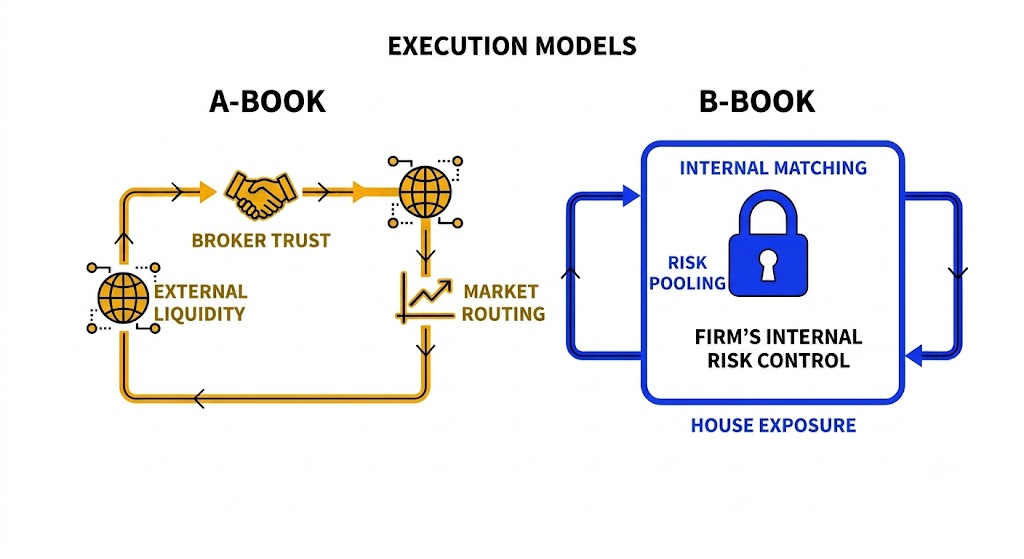
Prop firms generally operate using two main execution models: A-Book and B-Book, which describe how trades are handled behind the scenes.
Tier 1: A-Book
In an A-Book model, trader positions are passed through to external liquidity providers or live markets via brokers or execution partners. In this setup, trades are effectively mirrored into real market conditions, and outcomes depend on external price movement and liquidity.
Tier 2: B-Book
In a B-Book model, performance is tracked against live market pricing, but positions are managed within the firm’s own risk framework rather than routed directly to an external exchange. This is a standard practice across many trading programs and brokerage structures.
Most firms may use a combination of both models depending on account type, trading phase, or instrument class. Because approaches vary, traders typically review a firm’s execution disclosures to understand how order flow is managed.
What Traders Look For in a Prop Firm In 2026
When comparing prop trading firms, traders usually focus on a few practical factors that help explain how a program is structured and operated across different market conditions.
- One key factor is execution structure, where traders look at how orders are processed and whether trading activity is connected to external liquidity or managed within a defined internal system, depending on the account type and market.
- Another important factor is payout processing, where established third-party payment providers are sometimes used to handle withdrawals and maintain clear transaction records, depending on the firm’s setup and regional requirements.
- Traders also often consider platform consistency over time, including whether the firm has maintained stable rules and account conditions across different market cycles.
Because each program operates differently, it is useful to review the specific trading rules, execution notes, and account guidelines before participating to understand how the structure is designed.
Typical Costs in Prop Trading Programs
Prop trading programs generally involve a combination of one-time and optional recurring costs depending on the platform and tools used.
- Evaluation fee: The upfront cost to access the prop firm challenge and trading rules typically ranges from $30 to $300, depending on account size and program type
- Activation Fees: A one-time charge (in some programs) applied after passing the evaluation to activate the funded account — usually $50 to $200
- Platform fee: Cost for using professional trading platforms, charting tools, or execution software — generally $0 to $100 per month, depending on tools used
- Market data fee (futures): Subscription for real-time exchange data, such as CME or CBOT feeds required for futures trading — around $10 to $120 per month
- Trading costs (Forex/CFDs): Costs are built into spreads and commissions, typically averaging around $5 to $12 per standard lot round-turn, but can vary depending on instrument, liquidity, and market volatility conditions
Total setup costs vary by program, but most traders typically see initial evaluation costs plus optional monthly data or platform charges, depending on the instruments they trade.
Prop Firm Trading Rules and Payout Structure
Funded account payouts are typically governed by a set of conditions that work alongside the profit target, including minimum trading day requirements, consistency rules, and profit distribution thresholds.
Many firms structure payouts on a bi-weekly or on-demand basis, with profit splits generally ranging from 80-100% depending on the account tier. Some firms also require a minimum profit balance to remain in the account before the first withdrawal can be requested. This threshold — where applicable — is designed to maintain a buffer against drawdown exposure after a payout is processed.
Consistency rules are a separate but related consideration. Some firms assess how profits are distributed across trading days, not just the total amount earned. If a significant portion of gains comes from a single session, particularly during a high-impact news event, some firms may review that payout request against their consistency guidelines. Spreading performance across multiple sessions can be a straightforward way to satisfy these requirements where they apply.
The minimum trading day structure fits within this same framework. The remaining sessions after hitting a profit target are an opportunity to demonstrate that results are repeatable, which is generally what consistency rules are designed to confirm.
Platforms and Tools for Prop Trading in 2026
Platform selection in prop trading generally comes down to the asset class being traded and the execution environment the firm supports.
For futures trading, Sierra Chart and QuantTower (both desktop platforms built specifically for futures) are widely used alongside Tradovate, which functions as both a trading platform and its own data feed. These platforms support bracket order automation and connect to data routing services like Rithmic, which many traders prefer for execution speed and order management during fast-moving market conditions.
For forex and CFD trading, cTrader (a trading platform known for its clean interface and direct market access) and MetaTrader 5 are among the more widely supported platforms across prop firm evaluations. Both offer direct access to pricing data and support a range of order types and risk management tools.
Regardless of platform, features worth considering include one-click order entry, automated bracket orders, and reliable position management tools. During active market conditions, having these functions readily accessible can support cleaner execution and more consistent adherence to risk parameters.
Platform availability varies by firm, so confirming which options are supported before beginning an evaluation is generally a practical first step.
Tick Value, Position Sizing, and Market Liquidity In Prop Firm Trading
Understanding how price movements translate into dollar values is a foundational part of managing risk in prop trading, particularly during periods of elevated market activity.
Each instrument moves in its own unit of measurement — ticks in futures and pips in forex. The dollar value of each unit varies depending on the instrument and contract size being traded. For example, one full point in the E-mini S&P 500 (ES) is worth $50 per contract, while one full point in Gold (GC) is worth $100 per contract. In forex, one pip on a standard EUR/USD lot is worth approximately $10. Knowing these values helps traders calculate how much price movement their account can absorb before reaching the drawdown limit.
Position size directly affects this calculation. Trading larger sizes reduces the number of price moves available before a drawdown limit is reached. Many traders use smaller contract sizes — such as Micro E-mini contracts (MES, a smaller version of the standard E-mini S&P 500) or Micro Gold contracts (MGC, a tenth the size of a standard Gold futures contract) in futures, or micro-lots in forex — to allow more room for normal market fluctuation while staying within risk parameters.
During high-impact news events, such as the Consumer Price Index (CPI), which measures inflation, and the Non-Farm Payrolls report (NFP), which tracks monthly US job growth, spreads can widen and price movements can accelerate. This can cause orders to fill at different prices than expected, a common occurrence known as slippage. Accounting for this possibility when sizing positions, rather than assuming ideal fill conditions, is a practical part of evaluating risk management.
Tools like the Average True Range (ATR) can help traders gauge how much an instrument typically moves over a given period. Comparing normal ATR levels to those during news events gives a general sense of how conditions have changed and whether current position sizes remain appropriate.
Strategies for Passing and Keeping a Funded Account
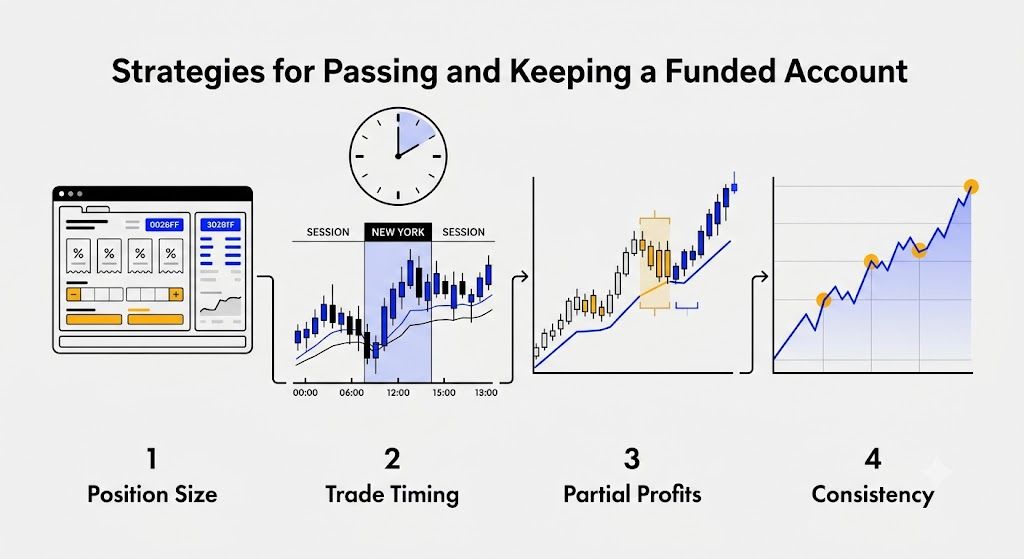
A disciplined approach to prop firm evaluations generally centers on consistent position sizing, selective trade timing, and staying within risk parameters throughout the full evaluation period — not just until the profit target is reached.
Position sizing is one of the more practical levers available during an evaluation. Many traders use smaller contract sizes, such as micro contracts in futures or reduced lot sizes in forex, to allow more room for normal market fluctuation while managing drawdown exposure. Scaling position size gradually, rather than increasing it aggressively during a strong run, can help protect account balance against sudden reversals.
Trade timing is another consideration. Some traders focus activity during higher-liquidity sessions, such as the New York open for futures, where order flow tends to be more consistent and execution conditions more predictable. Avoiding lower-liquidity periods, such as overnight sessions, can reduce the likelihood of wider spreads or unexpected fills.
Partial profit management is a technique some traders use to reduce exposure as a trade moves in their favor. Rather than holding a full position to a single target, closing a portion of the trade at an intermediate level locks in some gains while keeping a smaller position active. This can help limit the impact of a reversal on the overall account balance.
Throughout the minimum trading day period, maintaining the same approach to position sizing and risk management used during earlier sessions is generally the most consistent way to protect accumulated gains while continuing to meet evaluation requirements.
Final Verdict
Prop trading offers a defined path to access capital and develop a performance-based trading approach, but it works best when treated as a long-term process rather than a shortcut to quick returns.
Understanding the evaluation structure, including drawdown limits, minimum trading day requirements, and consistency rules, before committing to an account gives traders the clearest path toward meeting those conditions systematically. Starting with smaller position sizes, such as micro contracts, while a strategy is being refined and tested across different market conditions, is a practical approach many traders find useful early on.
For those looking to explore account options, Apex Trader Funding offers a range of evaluation accounts across different sizes and structures to suit different trading styles and risk tolerances.
DISCLAIMER: This article is for educational purposes only and does not constitute financial advice (NFA). All trading involves high risk, and past performance is not indicative of future results.
FAQs:
How do prop firms manage risk?
Prop firms protect capital by setting defined boundaries on how much an account can lose — both per session and overall. The main tools are trailing drawdown limits, which rise as profits grow; daily loss limits, which cap single-session losses; and consistency rules, which reward steady performance over time. Understanding these before you start is the foundation of a successful evaluation.
How to take profits when trading?
Taking profits means exiting a position at a predetermined level rather than guessing in the moment. Common approaches include fixed targets at key price levels, trailing stops that lock in gains as the trade moves in your favor, and scaling out by closing part of the position early. Setting these in advance removes emotion from the decision entirely.
Which days to avoid trading?
Some sessions carry a higher risk due to thin liquidity or unpredictable volatility. Most experienced traders avoid bank holidays, major news releases like NFP and FOMC decisions, and the Monday open and Friday close. Checking an economic calendar at the start of each week takes less than five minutes and can prevent unnecessary exposure on difficult trading days.