

Executive Summary: Prop firm evaluation fees typically range from $100 to $600, depending on account size and asset class. Beyond the initial fee, traders should also review platform costs, data fees, and drawdown rules before getting started. Understanding what the fee covers — and what it doesn’t — helps set realistic expectations from the start.
What Does a Prop Firm Fee Actually Cover?
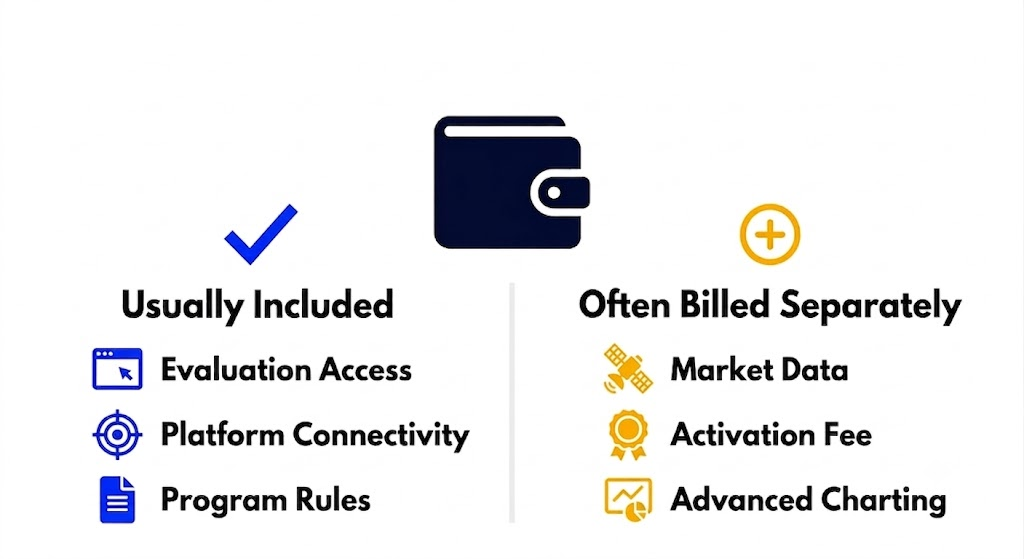
A prop firm fee typically provides access to an evaluation program, trading platform connectivity, and the opportunity to qualify for a funded account if the program requirements are met. The exact structure varies by firm, but the fee is generally linked to factors such as account size, asset class, platform access, and the trading rules associated with the evaluation.
Some firms include platform access and market data within the evaluation fee, while others may charge separately for services such as exchange data, advanced charting platforms, or account activations. Reviewing the full pricing structure before starting can help traders understand which costs are included upfront and which may apply later in the process.
What Determines Prop Trading Firm Fees by Asset Class?
Prop trading firm fees vary based on the asset class being traded, the technology required to support execution, and the services included within the evaluation or funded account. Account size, market data access, platform licensing, exchange connectivity, and the services included within the evaluation all influence the overall cost structure.
One of the most important distinctions is between an evaluation fee and any ongoing platform or data costs. The evaluation fee is typically paid to participate in the challenge, while additional charges may apply for services such as exchange data, trading platforms, or funded account activation, depending on the firm’s pricing model.
For many Forex accounts, the evaluation fee is a one-time payment with no recurring costs. Futures accounts may work differently — live exchange data often requires access to CME (Chicago Mercantile Exchange) infrastructure, so some firms include a monthly data fee alongside the initial evaluation cost. Depending on the program, a one-time activation fee may also apply when a funded account is first set up.
Common Cost Components in Prop Trading Firms
- Evaluation Fees: The initial fee required to access a challenge or assessment program, typically ranging from $100–$600, depending on account size, asset class, and program structure.
- Activation Fees: One-time charges that some firms apply when a trader progresses to a funded account, often $80–$200 when a funded account is activated.
- Market Data Fees: Common in futures trading, where access to exchange data packages may be billed separately, commonly $10–$150+ per month for futures market data packages.
- Platform Costs: Fees for trading platforms, charting software, or advanced execution tools, generally $10–$100+ per month.
Trading Costs: In Forex and CFD markets, costs may be reflected through spreads, commissions, or overnight financing charges, depending on the provider and instrument traded.
- Forex and CFD evaluations: typically $100–$600 as a one-time fee.
- Futures evaluations: typically $100–$350, with some programs also requiring separate activation or data fees.
- Equities-focused programs: typically $400–$650, depending on buying power, platform access, and market data requirements.
| Asset Class | Entry Fee Range (2026) | Additional Costs to Review |
| Futures (CME) | $100 – $350 (One-time) | Exchange data fees (typically ~$135/month); trailing drawdown rules apply to unrealized profits |
| Forex (OTC) | $100 – $600 (One-time) | Execution costs vary by platform |
| Equities (Direct Market Access) | $400 – $650 (One-time) | Stock borrow fees may apply when shorting |
Note: Futures activation fees are a separate one-time cost paid upon passing the evaluation and are listed separately in program terms. Fee ranges and cost structures vary by firm and program, and are subject to change. Always review the current terms of any program before starting.
Additional Prop Firm Costs to Consider Beyond the Evaluation Fee
While the evaluation fee is often the most visible cost, some programs may also include account resets, activation fees, platform subscriptions, or market data charges. Reviewing these expenses together can provide a more complete picture of the total cost of participation over time.
Many programs pass the large majority of eligible profits directly to the trader — typically 80% to 90%, or $800–$900 from every $1,000 generated on a funded account. Reviewing fees alongside that profit split helps assess whether a program aligns with your trading goals and approach.
Final Thoughts
The lowest-priced account is not always the most suitable option. Before purchasing an evaluation, take time to review the firm’s payout process, drawdown methodology, platform compatibility, and trading rules alongside the fee structure. Small differences in account rules can have a meaningful impact on the overall trading experience.
A useful approach is to compare several programs side by side and choose the one that best matches your preferred markets, trading style, and objectives. Understanding the complete framework before starting can help set realistic expectations and make it easier to get the most value from a prop firm account.
Disclaimer: Prop firm fees, rules, and costs vary by firm and program and may change over time. Always review the current terms and pricing before starting, and remember that trading involves substantial risk.