
Executive Summary: Yes, Day trading is legal in Canada, but its tax treatment depends on how the activity is conducted. The Canada Revenue Agency (CRA) may treat systematic, frequent, short-term trading as business income rather than capital gains (50% inclusion). A TFSA does not shelter income from a trading business, making account choice and accurate records important.
Introduction
Day trading is legal in Canada, but traders must understand how it fits within the country’s tax system. The Canada Revenue Agency (CRA), which administers federal tax laws in Canada, determines if day trading profits should be treated as capital gains or business income. This allows trading activity to be taxed according to how it is conducted, rather than simply by the type of account used.
This also affects a Tax-Free Savings Account (TFSA), which is a CRA-registered account designed to help Canadians grow eligible savings and investments tax-free. If trading inside a TFSA resembles a business, its profits may become taxable. This article explains how the CRA evaluates trading activity and when TFSA concerns may arise.
How Does the CRA Tax Day Trading Profits in Canada?
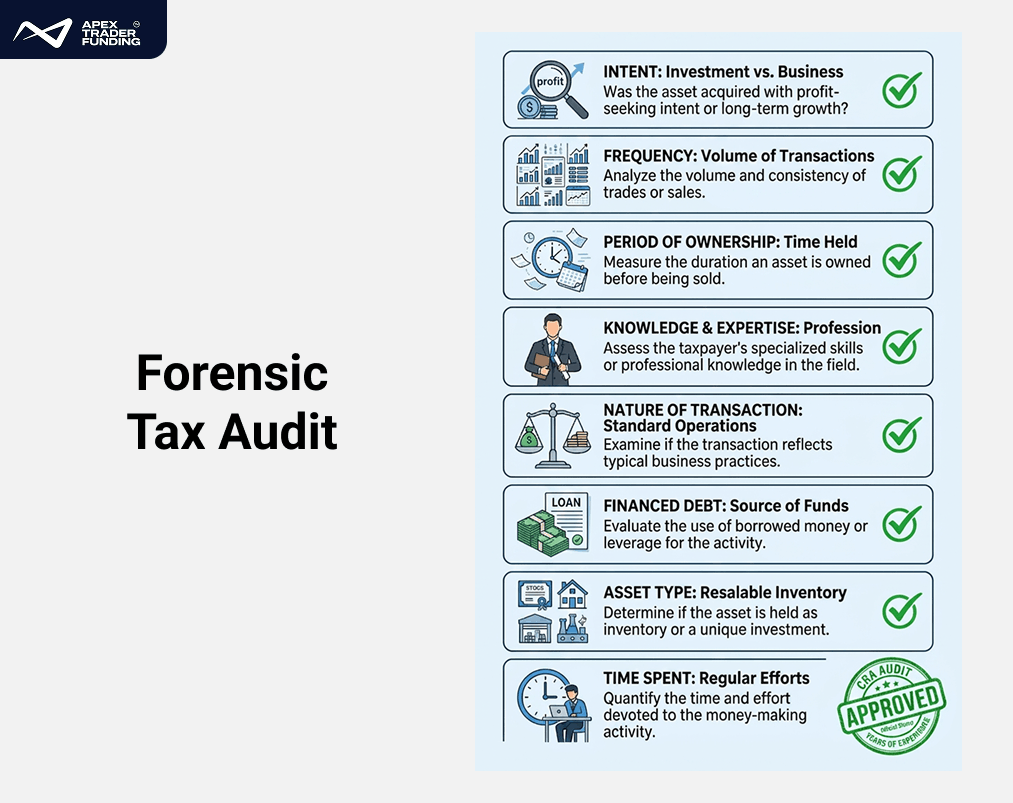
The CRA taxes day-trading profits as business income when trading resembles a business; otherwise, it generally treats them as capital gains. Classification determines the inclusion rate, available deductions, and loss treatment. The CRA assesses overall conduct rather than applying an automatic trade-count threshold.
Canadians can legally open brokerage accounts and place intraday trades. The main distinction concerns how the resulting profits and losses are reported.
The CRA may consider:
- The frequency and volume of transactions.
- How long securities are held.
- The trader’s market knowledge and experience.
- The amount of time spent researching and trading.
- Whether purchases are financed through margin or other debt.
- Whether the securities are speculative in nature.
- Whether the activity is organized and conducted like a business.
These factors are considered together. High trading frequency alone does not create an automatic classification, and the CRA does not publish a fixed number of trades that separates an investor from a business operator.
| How the CRA classifies the activity | How the income is taxed | How expenses and losses are treated |
| Investing on capital account | Generally, 50% of the net capital gain is included in taxable income. | Capital losses can generally reduce capital gains, subject to applicable tax rules. |
| Operating a trading business | The full net business profit is included in taxable income and taxed at the trader’s applicable rate. | Reasonable expenses incurred to earn trading income may be deductible. Business losses may also receive different treatment from capital losses. |
| Operating a trading business inside a TFSA | The TFSA trust may owe tax on income connected to the trading business. | Normal TFSA tax advantages may not protect business income, and registered-account rules affect how expenses and losses are handled. |
Losses receive different tax treatment depending on how the CRA classifies the trading activity:
- Capital loss: Generally offsets taxable capital gains only.
- Business loss: May offset other income, including employment or business income, subject to tax rules.
Election for Canadian Securities: Eligible taxpayers may file Form T123 under subsection 39(4) to have qualifying Canadian securities treated as capital property. The election generally applies to the election year and later years and cannot be revoked. It does not cover every security or taxpayer and does not allow traders or dealers to automatically obtain capital-gains treatment.
Business classification does not mean that profits face a 100% tax rate. It means the full net profit is included in income rather than only half of a capital gain. The actual tax payable depends on the trader’s total income, province or territory, deductions, and marginal tax rate. Reporting also differs by classification: capital transactions may appear on a T5008 slip, while business trading activity is generally reported using Form T2125.
When trading constitutes a business, reasonable expenses may be deducted from gross trading income. Eligible costs can include platform fees, market data, commissions, margin interest, software, and home-office expenses. For example, $80,000 in gross income minus $15,000 in documented deductions results in $65,000 of net business income.
Home-office expenses may be deductible if the workspace is the trader’s principal place of business or is used exclusively and regularly to meet clients. Simply using the space continuously for trading does not, by itself, satisfy the eligibility requirements. Other expenses must also meet CRA deductibility rules and cannot be claimed solely because they relate to trading.
Why Day Trading in a TFSA Can Become Taxable
A TFSA normally shelters investment income and capital gains, but that protection does not extend to a business carried on inside the account. If the CRA determines that trading in the TFSA constitutes a business, the TFSA trust may be subject to tax on income earned from that trading business. This does not mean the entire account automatically loses its tax-free status.
Frequent intraday trading does not automatically make a TFSA taxable. However, the CRA looks at the overall trading activity, not just the account type. If your trading resembles a business, gains that were assumed to be tax-free could later become taxable. If you plan to actively trade in a TFSA, it’s a good idea to get advice from a tax professional based on your situation.
Beyond potential TFSA Trust Income Tax on business income, TFSA concerns also extend to losses when identical investments are traded across registered and non-registered accounts. Losses inside a TFSA cannot offset taxable gains outside it. A related loss-treatment issue is the Superficial Loss Rule, also known as the Wash Sale Rule. It may apply when a security is sold at a loss, and the identical property is acquired within 30 days before or after the sale.
The taxpayer or an affiliated person must also still own the replacement property 30 days after the sale. In this case, the loss is excluded from the current tax calculation, while gains remain included; the denied loss can usually be added to the Adjusted Cost Base (ACB) (the total cost of an investment adjusted for purchases, commissions, and certain other transactions) of the replacement property.
Note: If you sell an investment at a loss in a non-registered account and acquire the identical investment through your TFSA during the superficial-loss period, the loss may be permanently denied if the replacement investment is still held 30 days after the sale. It cannot be claimed against future capital gains, and any cost-base adjustment inside the registered account provides no usable tax benefit.
Importance of a Forensic Trade Log
A detailed trade log can be a useful part of a Canadian trader’s recordkeeping process. It helps organize trading activity, document transactions, and support the information reported for tax purposes. However, a trade log does not determine tax classification or, by itself, establish the trader’s original intention.
Useful records include:
- Trade dates and settlement information.
- Ticker symbols and position sizes (eg., shares, contracts, etc).
- Entry and exit prices.
- Commissions and transaction fees.
- Brokerage and market-data statements.
- Margin-interest records.
- Adjusted cost base calculations where capital treatment applies.
- Receipts supporting any claimed business expenses.
Maintaining these records can make it easier to review trading activity, calculate amounts accurately, and provide supporting documentation if requested by the CRA.
Final Thoughts
Day trading is legal in Canada, and the tax rules are intended to distinguish personal investing from business-like trading activity. Traders who understand which classification applies, maintain clear records, and report their activity consistently are better positioned to meet CRA requirements. This structure is part of treating active trading as a professional operation.
To reduce tax and audit uncertainty, some traders keep active trading in a non-registered account while reserving their TFSA for long-term investments. Documenting every cost and decision from day one provides supporting records if the CRA reviews the activity.
For traders who want to separate their active intraday strategy from their personal registered accounts entirely, evaluation-based funding platforms such as Apex Trader Funding offer a structurally clean alternative. However, the account model, whether trading is simulated or involves firm capital, and the resulting Canadian tax treatment depend on the provider’s terms and the trader’s circumstances. Such programs should not automatically be treated as separate from a trader’s personal tax or reporting obligations.
Tax disclosure: This article provides general information and does not constitute legal or tax advice. Tax treatment depends on individual circumstances and current law. Traders should consult a qualified Canadian tax professional before reporting active trading income.