Executive Summary
Forex and futures are two popular trading markets, but they differ in how trades are executed, priced, and managed. Forex offers flexible trade sizes, lower entry barriers, and continuous weekday trading, while futures provide centralized pricing, transparent trading activity, and standardized contracts. The right choice depends on a trader’s capital, preferred trading environment, and need for market transparency.
What Are Forex and Futures?
Forex and futures are both financial markets that allow traders to participate in price movements without owning the underlying asset directly. Forex focuses on currency pairs, while futures use standardized contracts linked to assets such as stock indexes or commodities.
Understanding Forex
Forex, short for foreign exchange, is the global market where currencies are traded against one another. Currencies are always traded in pairs, such as EUR/USD or GBP/USD. When a trader buys one currency, they are simultaneously selling another currency within the pair.
Forex trading takes place through a decentralized network (there is no single central marketplace) of brokers and financial institutions rather than a single central exchange. Brokers obtain pricing from liquidity providers, which are large banks and financial institutions that supply buy and sell prices to the market. Because of this structure, the market operates continuously throughout the business week, allowing traders to participate across different global trading sessions.
Understanding Futures
Futures trading involves buying or selling standardized contracts whose value is tied to an underlying asset. These contracts can be based on stock indexes, commodities, currencies, or other financial markets. Unlike forex, futures contracts have predetermined specifications, including contract size and expiration date. An expiration date is the date on which the futures contract reaches the end of its agreed term. Traders must either close the position or roll it into the next available contract before this date.
Futures trading takes place on centralized exchanges, such as CME Group, where all participants access the same market prices and trading information. This centralized structure provides transparent pricing and allows traders to view official market activity, including trading volume, throughout the trading session.
Examples
| Forex | Futures |
| EUR/USD | Stock Index Futures |
| GBP/USD | Oil Futures |
| USD/JPY | Gold Futures |
| AUD/USD | Currency Futures |
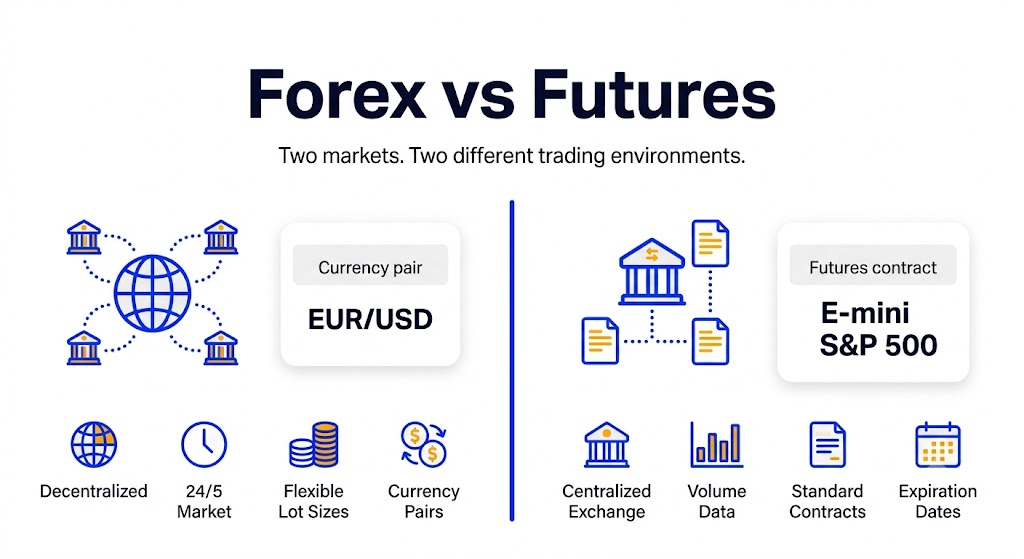
What Are the Main Differences Between Forex and Futures?
Forex and futures share some similarities, but they differ in market structure, trading hours, contract specifications, and available market data. Understanding these differences helps traders evaluate which environment better aligns with their preferred trading style and analytical approach.
| Feature | Forex | Futures |
| Market Structure | Decentralized broker network | Centralized exchange |
| Trading Hours | 24 hours during weekdays | Nearly 24 hours during weekdays |
| Trade Size | Flexible lot sizes | Standardized contracts |
| Market Data | Limited overall market volume visibility | Exchange-reported volume data |
| Expiration Dates | No expiration | Contracts expire periodically |
| Pricing | Broker-provided quotes | Exchange pricing |
Understanding Trading Volume and Trade Size
Trading volume refers to the amount of trading activity occurring within a market during a specific period. Higher volume generally indicates greater participation from buyers and sellers, while lower volume may indicate reduced trading activity during that period.
One difference between forex and futures is how trading activity and trade size are measured. In forex, positions are typically measured using lots, which represent units of currency being traded. Common sizes include standard lots, mini lots, and micro lots. Because forex operates through many brokers and institutions, traders usually see activity data from their broker rather than the entire global market.
In futures, positions are measured using contracts, which are standardized agreements created by the exchange. Each contract has a predefined size and value. Futures exchanges also publish official trading volume, allowing traders to see how many contracts were traded across the entire market during a session. Many futures traders use this information to assess how actively the market is being traded during a given session.
What Costs Should Traders Consider?
Both forex and futures involve trading costs that can affect overall results. While the cost structure differs between the two markets, understanding common expenses helps traders evaluate the real cost of trading in each market.
Forex Trading Costs
Common forex costs may include:
- Spread: The difference between the buying price and selling price of a currency pair.
- Commission: A fee charged by some brokers for executing trades.
- Overnight Financing: A charge that may apply when positions remain open after the trading day ends.
Futures Trading Costs
Common futures costs may include:
- Brokerage commissions: Fees charged by a broker for executing buy and sell orders.
- Exchange fees: Charges collected by the exchange where the trade is processed.
- Clearing fees: Fees associated with settling and processing completed trades between buyers and sellers.
- Market data subscriptions: Optional fees for access to real-time exchange prices, charts, and market information.
Because exchanges publish fees openly, traders can generally see the cost structure before placing trades.
Which Market Is Better for Beginners?
Neither forex nor futures is universally better for beginners. The most suitable choice depends on a trader’s learning preferences, analytical style, market interests, and comfort with each market’s structure. Understanding the strengths of both environments can help traders make a more informed decision.
Forex May Appeal To Traders Who:
- Prefer flexible position sizes (how much is being traded in a single position)
- Want access to the market throughout the business week
- Focus primarily on currency markets
- Prefer a simpler account setup process
Futures May Appeal To Traders Who:
- Want exchange-reported volume data
- Prefer centralized market pricing
- Trade stock indexes or commodities
- Value standardized contract specifications
Final thoughts
Forex and futures are distinct markets with different structures, purposes, and trading environments. The better choice is the one that best fits a trader’s objectives, preferred market structure, and learning style.
For traders who are drawn to the transparency and standardized nature of futures markets, evaluation-based environments such as Apex Trader Funding can offer a practical way to become familiar with futures contracts, trading volume, and execution processes while developing a structured trading approach.
FAQs:
Is it better to trade futures or forex?
Neither market is universally better; the right choice depends on your strategy and risk tolerance. Futures provide centralized pricing and exchange-reported volume data. Forex offers flexible position sizes and continuous weekday access. Both are legitimate starting points depending on what a trader is looking to develop.
Do you trade futures the same as forex?
No. Futures and forex use different market structures and execution systems. Futures trade through centralized exchanges like CME Group with standardized contracts and transparent volume data, while forex trades through decentralized broker networks with flexible lot sizes. This affects pricing, liquidity, and how trades are executed.
Do you need 25K to trade futures?
No. The U.S. Pattern Day Trader (PDT) rule does not apply to futures trading, so traders can start with much smaller accounts. Many brokers offer reduced intraday margin requirements for beginner-friendly micro contracts.
- Day trading margins can range from $50 to $500 per contract
- Micro E-mini S&P 500 contracts have lower entry costs
- Smaller accounts can access futures markets that use leverage, meaning a smaller deposit controls a larger market position than the deposit alone would suggest
This makes futures trading more accessible than active stock day trading.