
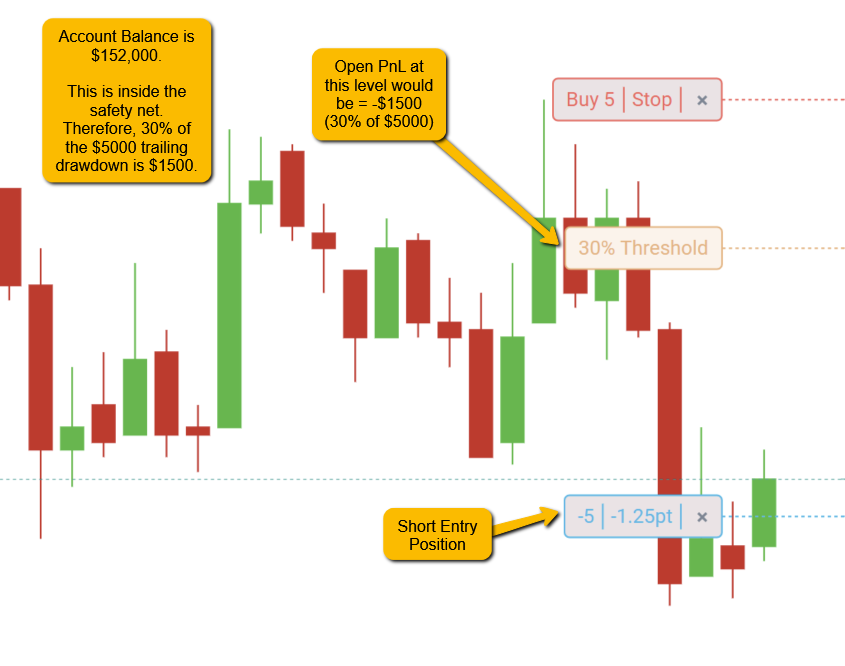
The 30% Negative Profit and Loss (P&L) Rule, known as Maximum Adverse Excursion (MAE), limits the loss a trader can incur on any open trade or trades, providing a structured approach to risk management. Under this rule, the live, unrealized, open negative P&L cannot exceed 30% of the account’s profit balance at the start of the day.
This is not a daily loss limit, but a control to prevent excessive loss on any individual trade. At any point, your open negative P&L should not surpass 30% of your start-of-day profit. Regularly monitor your trades and exposure to stay compliant with the rules.
Limit on Losses: Open trades should not exceed a 30% negative drawdown from the account’s profit balance.
Example: For a $50,000 account, if the profit balance is $4,000, a trader should not allow a drawdown exceeding $1,200.
New/Low Profit Accounts: For accounts that are new or have low profits, the 30% rule is based on the trailing threshold (e.g., 30% of $2,500 on a $50,000 account would be $750).
Adjustment Based on Growth: If the end-of-day (EOD) profit balance doubles the safety net, traders may use a 50% drawdown limit instead of 30% starting with the next full trading session.
Example:
For a $50,000 account, if you accumulate $2,600 in profit and pass the safety net, your risk is calculated based on 30% of that $2,600. If your profits rise to $5,200, your drawdown allowance can increase to $2,600 (50% of $5,200).
At Apex Trader Funding, responsible trading is at the core of our practices, and managing drawdowns is a crucial part of that. Here’s what you need to know:
- Continuous Monitoring: We encourage you to regularly monitor your trades and adjust your positions as needed to stay within these limits. If your drawdown approaches 30%, consider closing or adjusting your trades to avoid breaching the limit. Quick adjustments can help prevent any compliance issues.
- Temporary Exceedances: If your drawdown momentarily exceeds 30% but you act quickly to manage the situation, there won’t be an automatic penalty. However, repeated or significant breaches could lead to warnings or account restrictions.
Adhering to these guidelines can ensure that your trading strategy remains robust and sustainable. These terms should be strictly followed to ensure consistent compliance with Apex’s 30% negative P&L rule for Legacy Accounts.
Static Accounts
The 30% Negative P&L rule for Legacy Static Accounts is designed to help manage risk by ensuring that losses are kept within safe limits. The rule applies in two stages: one when the account balance is below the safety net, and another when it exceeds the safety net.
- Below the Safety Net ($2,600): When the account balance is below the $2,600 safety net, the maximum loss per trade is $187.50. This is 30% of the fixed $625 drawdown that applies to accounts at this stage. Essentially, until the balance surpasses the safety net, the rule restricts your loss on any single trade to $187.50.
- Above the Safety Net ($2,600): Once the account balance exceeds $2,600, the 30% Negative P&L rule is recalculated based on the current profit balance in the account. For example, if your account reaches $103,000, which includes a $3,000 profit, the maximum allowable loss per trade is $900 (30% of the $3,000 profit).