The front-month is considered the futures contract with the most volume. This is important as some platforms require you to trade the front-month contract at all times. However, it is also important to understand how to identify the front-month contract for platforms that allow trading of continuous contracts so that you know when to expect changes in liquidity and volatility. You can find out more information about contract codes on the CME Website HERE.
Impact when trading the wrong contract
When trading the wrong contract code, there is very little liquidity because not many people are trading it. This is important to understand, as Peak Balance is calculated using the next available Bid and Ask prices. When liquidity is low, the Bid/Ask spread becomes very wide.
Because of this widespread, your account can be liquidated instantly, even if the market price looks normal. The example below shows how this can happen.
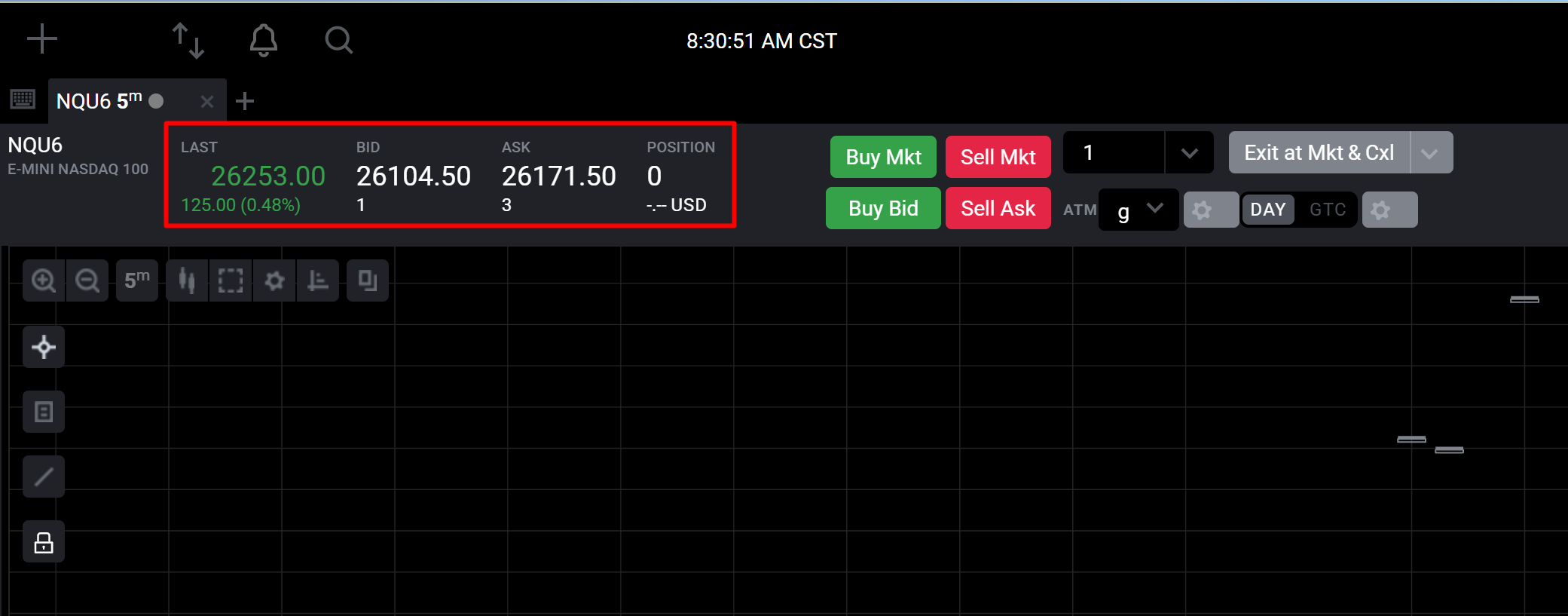
At the time of writing, the current front-month contract is NQH6. This contract will roll over to NQM6 in March and then to NQU6 in June. The image below shows prices for NQU6 loaded on a Tradovate chart.
The last traded price shown on the chart (in green) is 26,253.00. However, the next available Bid price is 26,104.50, and the next available Ask price is 26,171.50. This creates a price gap of more than 70–100 points.
A 100-point spread on NQ equals over $2,000 when trading just one contract. This is why accounts can be liquidated instantly when the front-month contract is not traded.
Steps to identify the front-month contract
- Follow the useful links below for each instrument, or alternatively, find the instrument overview on the CME website directly.
| Instrument Name and CME Link | Symbol | Instrument Name and CME Link | Symbol |
| Equity Futures | Metal Futures | ||
| E-Mini Dow ($5) | YM | Gold | GC |
| E-Mini S&P 500 | ES | Copper | HG |
| E-Mini NASDAQ | NQ | Silver | SI |
| E-Mini Russell | RTY | E-Mini Silver | QI |
| E-Mini S&P Midcap 400 | EMD | E-Mini Gold | QO |
| Nikkei 225 (USD) | NKD | Platinum | PL |
| Currency Futures | Palladium | PA | |
| Australian Dollar | 6A | Micro Futures | |
| British Pound | 6B | Micro E-Mini Dow | MYM |
| Japanese Yen | 6J | Micro E-Mini S&P 500 | MES |
| Canadian Dollar | 6C | Micro E-Mini NASDAQ | MNQ |
| Swiss Franc | 6S | Micro E-Mini Russell | M2K |
| Euro FX | 6E | E-Micro Gold | MGC |
| New Zealand Dollar | 6N | Micro Crude Oil | MCL |
| Agricultural Futures | E-Micro Australian Dollar | M6A | |
| Lean Hogs | HE | E-Micro Euro | M6E |
| Live Cattle | LE | ||
| Feeder Cattle | GF | Energy Futures | |
| Soybeans | ZS | RBOB Gasoline | RB |
| Soybean Oil | ZL | Crude Oil | CL |
| Corn | ZC | Natural Gas | NG |
| Wheat | ZW | E-Mini Crude Oil | QM |
| Soybean Meal | ZM | E-Mini Natural Gas | QG |
| Cryptocurrencies | Heating Oil | HO | |
| Micro Bitcoin | MBT | ||
| Micro Ether | MET | ||
- Using the image below, you need to identify the contract month that is trading with the most volume. This is the front-month.
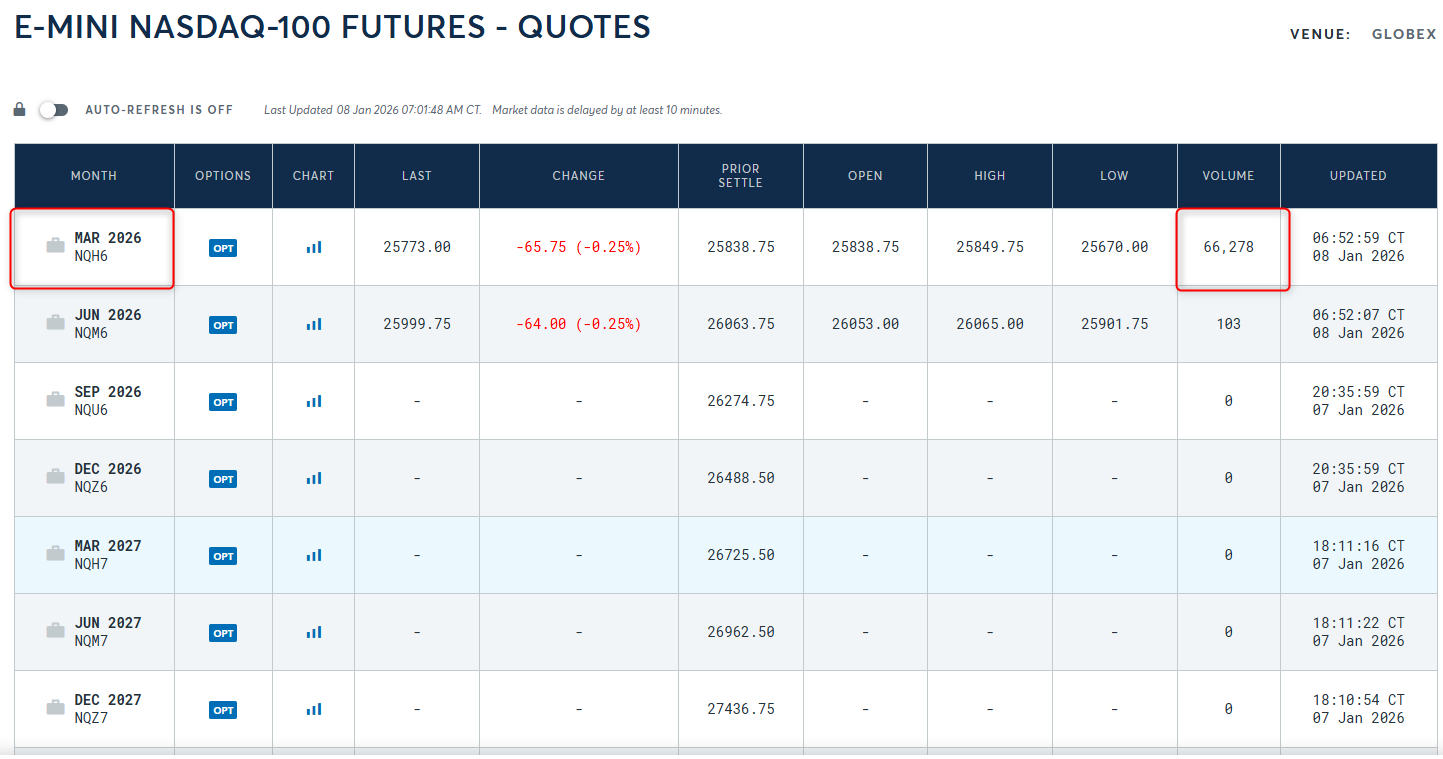
- Finally, you use the table below to determine the contract code for each month. E.g, for the example above with NQ March 2026, you would need to trade NQH6. However, you can see on the CME NQ Quotes table above, the contract code is stated below “MAR 2026”. Please note: Some platforms may use 6 or 26 for the contract code; ensure you use the correct one for your trading platform.
|
January – F |
July – N |
|
February – G |
August – Q |
|
March – H |
September – U |
|
April – J |
October – V |
|
May – K |
November – X |
|
June – M |
December – Z |
If you have additional questions or need clarification specific to your account, our Support team is always happy to assist.